Friday, March 31, 2006
Eensy Flowers
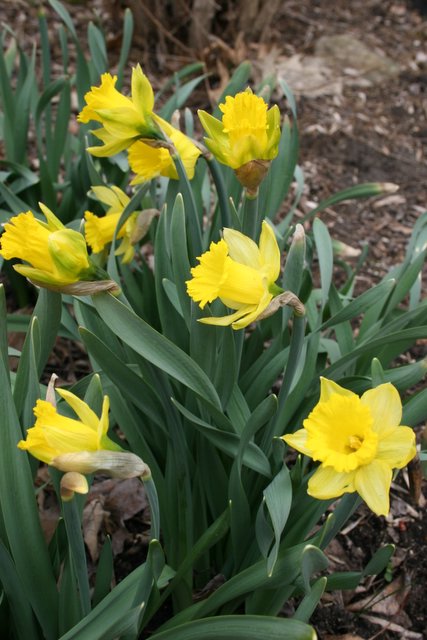
 One thing about the early garden: most of the flowers are eensy, staying close to the ground, out of the raw wind... here are two little daffodils and a little iris blooming today.


Thursday, March 30, 2006
A Foot In The Door
 Spring finally has a foot in the door, and some of the earliest woodland flowers are starting to bloom, like hellebores, which are just starting to unfold their flowers, some like the finest shot silk.
 The hepaticas are all just starting to bloom, raising their delicate appearing flowers slowly from the leaf litter. Above is Hepatica insularis, an uncommonly cultivated species native to coastal Korea and the nearby islands. it is unusual in that it is deciduous in our climate, so it begins blooming before the leaves appear.
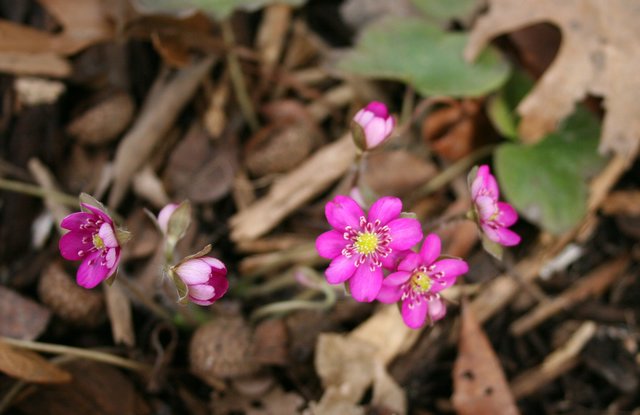 This is the common Hepatica asiatica var. Japonica, which comes in many shades and patterns, double and single flowered. It is collected passionately in Japan, with some breathtaking plants with equally breathtaking prices...I have named my variety "Plain Old".
 Another charming little Primula juliana, this one clothed in bright blue.
 The flowers of Petasites are now mature... in the warm sun, they have a very pronounced aroma of Ben Gay, with a slight musky undertone like Fritillaria imperialis. The whole pathway next to them is perfumed with this unique bouquet, which no visitor to our garden has ever correctly attributed to this plant.
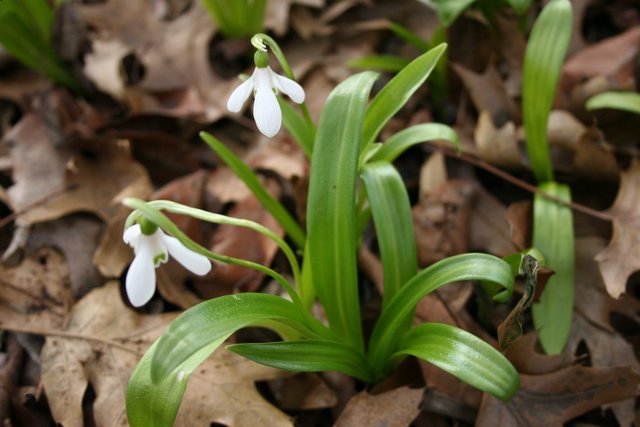 I had posted before about Galanthus ikariae, a new species of snowdrop in the garden, planted last fall, and of questionable hardiness; so far it is a success... the flowers are rather small, but I very much like the bright, shiny green foliage, which is a nice contrast to the cool, bluish green foliage of Galanthus elwesii, which is spreading everywhere in the garden. (disclaimer: I've now found out that this is Galanthus woronowii; apparently it's commonly mis-labeled as ikariae in commerce... see blog entry 1/17/07).
Wednesday, March 29, 2006
The Garden In Sprinter
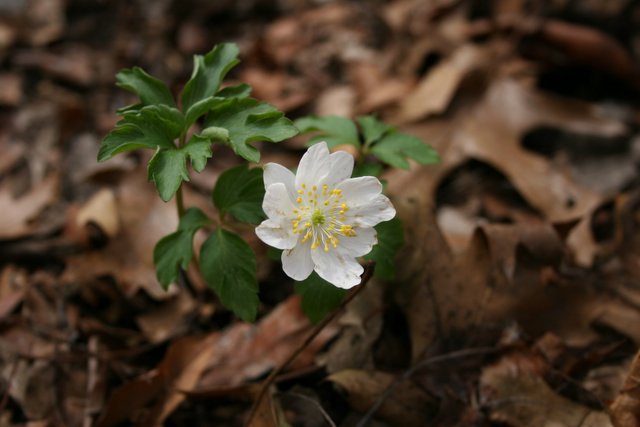 March has been a bust; well-below normal temperatures (15 days in a row of temperatures below the norm), with day after day of cold, dry, cloudy weather. We have been marooned between spring and winter, in sprinter. Finally this afternoon the sun came out, and the temperature edged above fifty degrees. The bees reappeared, so eager that they seemed to hardly alight on a squill or a crocus, before they were off again to the next bloom. Many small plants raised their faces in wonder at this strange light in the sky... hopefully tomorrow they'll hear their first thunder. Above is Anemone nemerosa, nestled under an azalea.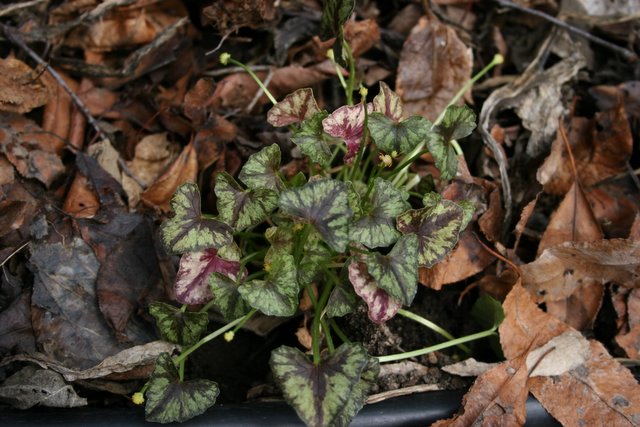
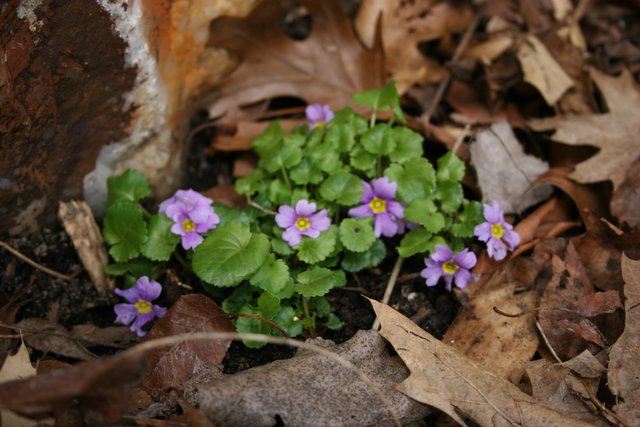 Primula "Cheri Fluck"; a diminutive Juliae hybrid, here tucked in next to a quartz boulder.
 I Wanda In The Garden
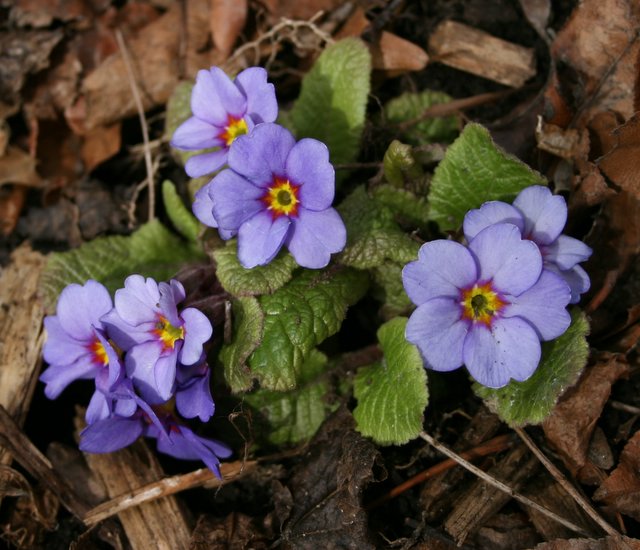 The afternoon sunshine today was just enough to stir the early Wanda hybrid primroses to life, with a few brightly colored blooms showing here and there, topping the newly emerging leaves... later, the larger plants will be covered with flowers so that the foliage can barely be seen. The Wanda hybrids were some of the earliest crosses to be made with Primula juliae, a small, brightly colored species discovered by plant explorers in 1900, growing in the Caucasus in mountain forests, crossed, in the case of the Wandas, mainly with Primula vulgaris, the common primrose of English meadows. The purple of P. juliae tends to dominate the yellow of vulgaris, so these hybrids tend towards purple-red flowers; they apparently are mostly vulgaris, so vary in hardiness (juliae gives more hardiness to the hybrids), and are slightly "looser" plants than crosses that contain more juliae, and as both vulgaris and juliae have single flowers on short stalks (acaulis) so do these hybrids, for the most part. The foliage of Wandas is somewhat dark green, almost bronze, with hints of red edging, seen best as below, when the foliage is first emerging. There sometimes is a little confusion in that the name Wanda should denote a specific, hardy hybrid of this group, which is claret-purple, and on the smaller side, whereas Wanda group or Wanda hybrids come in many bright colors; all I have seen have contrasting yellow eyes.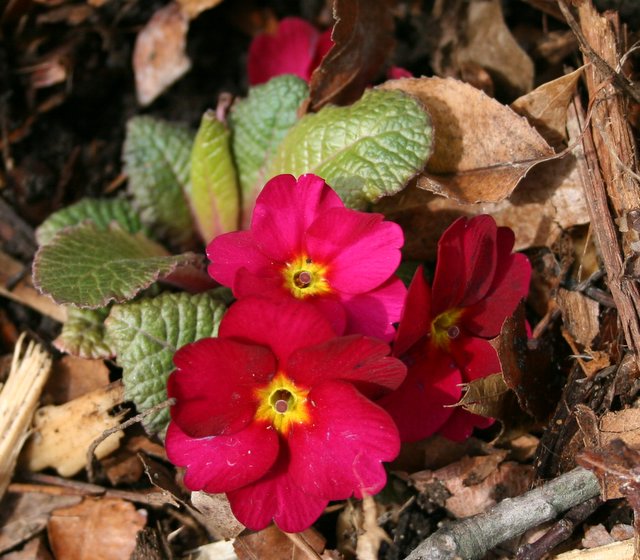
Wednesday, March 22, 2006
Hardy Primroses
 Primroses are generally thought of as being rather delicate in the garden, and most of the species are, in fact, difficult to impossible to grow in the open garden in the midwest... if our winters don't get them, our summers do. There are, though a number of species and groups of hybrids that are quite reliable, asking only decent, loose soil, some afternoon shade, and reasonable moisture (so I'm talking about plain old shady spots in the garden, not artificial bogs or cool stream banks). I do grow other types of primroses in my garden than are on today's list; some seem quite hardy but I haven't grown them long enough to feel comfortable recommending them, some of them haven't made up their minds whether they want to continue growing here, some look pathetic enough that I secretly wish they would give up, and then there are a number that seem to be doing very well, but they either have a reputation for being short-lived, or just a reputation as being a little more finicky, so they're not currently in my hardy list. I would stress that my hardy list would be different even in different parts of the midwest; there are many more primroses that I could grow well if I lived, for example, in Minnesota, where summer nights are cooler.
Pictured above is Primula kisoana, which is almost a weed here; it is unusual in that it spreads by underground runners, reminding me somewhat of a strawberry patch, with its hairy, slightly scalloped leaves. It is a toughie; it likes to spread out into the bark chip paths, where I can just pull up plants anytime I want, and pot them up or transplant them; they will grow anywhere for me... with their very hairy leaves, they seem the most drought and heat-resistant of any I grow, not wilting even in hot sun or dry wind, that would turn other primroses to mush. Primula sieboldii is often called the beginner's primrose, with its special advantage being that the foliage goes dormant in the late summer, so it is more resistant to heat and drought (though even dormant primroses don't want to be baked). In Japan, this primrose is keenly collected and grown, as there are numerous named clones, some quite pricey; I suppose one could come up with a dozen or so varieties in this country without too much trouble. I might like a close relative of sieblodii a tiny bit better: Primula cortusoides... it is a little smaller and perhaps a little more delicate, but I like it because its foliage grows in a better clump than sieboldii (which tends to run about). The common species primroses of England: vulgaris, elatior, and veris, also are pretty reliable, as are the hybrid complexes between these three species, and those crossed with the species Primula juliae, which all are sold under a variety of labels: vulgaris (should be called "x vulgaris"), polyanthus, acaulis, juliae (should be "x juliae" or juliana), and such names as Pacific Giants, Danova, Wanda, etc. There is a lot of variation in hardiness in this whole group, and a major topic in itself would be just sorting out the confusing names and parentage (which I about half understand but will nevertheless tackle sometime in this blog). Primula denticulata is the last member of my list, and probably the most delicate of the bunch; it really would like a little cooler, moister summer than we can provide; it persists, but multiplies fairly slowly, and occasionally disappears. The beauty of its flowers makes up for its shortcomings.
There are other primroses that likely will eventually join this list: saxatilis, polyneura, yuparensis, rosea, and hopefully many others, but I could be happy and have quite a primrose garden just with these hardiest of the hardy.
Tuesday, March 21, 2006
What A Difference A Year Makes...
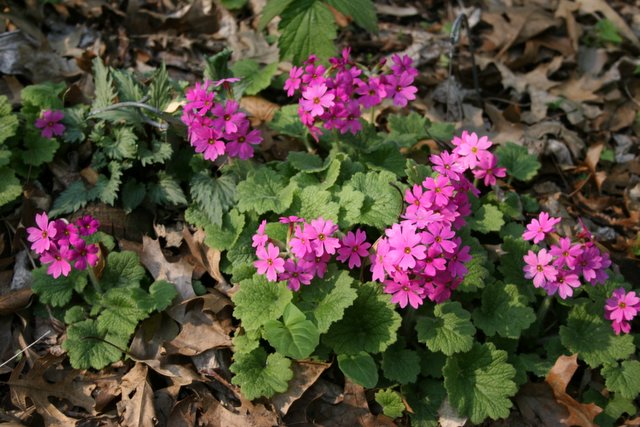
 A year ago today, the whole garden was waking up, as shown in the first three pictures, with splashes of color, bees buzzing, and birds chirping; the last picture shows the garden today...SIGH!


Sunday, March 19, 2006
Orchids, Mustard, And Vegetables
 Early this afternoon, on a pleasantly mild Sunday, Liz and I met up with some other members of the Johnson County Heritage Trust, which is involved in preserving natural areas in our county, to assess and start clearing, the garlic mustard from a new preserve consisting of forty acres of nice, hilly woods. Our group headed down a large ravine, marking clumps of garlic mustard with tree tape, and pulling as much as we could. It was alarming to see how many colonies of mustard were already present, and we soon had marking tape scattered down both sides of the ravine. It was especially distressing, as the area contained thousands of plants of Aplectrum hyemale, the Adam and Eve orchid, shown by their hibernal leaves lying on the leaf litter. This is exactly the type of wildflower that garlic mustard will totally wipe out. Also seen were early leaves of spring beauty and Dutchman's breeches, so undoubtedly this moist ravine is home to a multitude of spring flowers. We were able to get a start on the mustard, but thousands of plants were undoubtedly left. Seeing all those wild orchids in peril made me vow to take on the ravine as a project (I figure I've hand pulled 50,000 mustard plants from the garden portion of our woods in the last three years... what's a few more thousand weeds?)
Back home in the late afternoon sun, it was time for a garden stroll; the red-wing blackbird was down by the pond, singing Spring-Is-He-e-e-re, accompanied by the Wir-r-r-r of a flicker, the whistled spring call of the chickadee, blue jays calling across the valley, the sweet Peter call of a titmouse, and percussion was supplied by a downy and a hairy woodpecker. The hellebores are pushing up their shiny foliage and their flower buds, daffodils are appearing everywhere, by the thousands, and the Japanese butterbur (shown above), Petasites Japonicus Giganteum, has all its flowers open; strange, light greenish, vegetable-like clusters, looking like so many heads of cauliflower lying on the ground. The leaves are just starting to poke up through the earth, at this stage giving little hint at the gigantic plants that will soon emerge, to continue their battle to escape their bed and take over the garden path. They might take pause; I've just spent three hours destroying garlic mustard, and am not to be trifled with today.
A cold wind then came up all at once, tattering the warm afternoon, so it was time to go see if Liz might be interested in going to Hamburg Inn for a cheeseburger.
Saturday, March 18, 2006
Urban Jungle
 We like to think we're in sort of a wilderness retreat here; we have three acres of woods, backed up by a four acre pond, and when the leaves are on the trees, we can't see any of our neighbors (I'm sure they can hear us more than they'd like, but they're sweet about it, and most of them like fireworks anyway). Actually, though we're seemingly in our own little world, we're just outside of town. Nevertheless, one must use one's keen woodsman's skills around here sometimes... take for example the above spot in a muddy trail. There are actually three different sets of animal tracks present, and I feel no less the naturalist for saying that the small set on the left are from P.J. the kitten, and the set on the right are from Sadie the cat. Right in the middle is a deer hoof-print. Next week: urban scat!
Friday, March 17, 2006
Looking Close
 We've been stuck between winter and spring; a huge dome of Arctic air has been planted just west of Hudson Bay, with a constant flood of cold air flowing southward over the Great Lakes, then spreading out all over the upper midwest, blowing into every little nook and cranny, until it whistles into our valley, ruffling the pond's surface into a myriad of bright diamonds in the March sun. The garden has also been stuck, with a quick walk not seemingly showing much progress, so it's a day to look more closely.
  In a sheltered spot, purple crocuses are open, a magnet for the few honey bees brave enough to navigate the cold air.
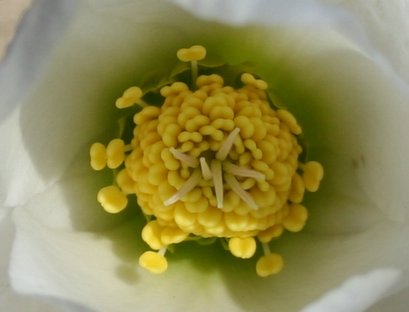 Of course we have to stick our nose into the first hellebore to open, Helleborus niger.
Thursday, March 16, 2006
Christmas In March
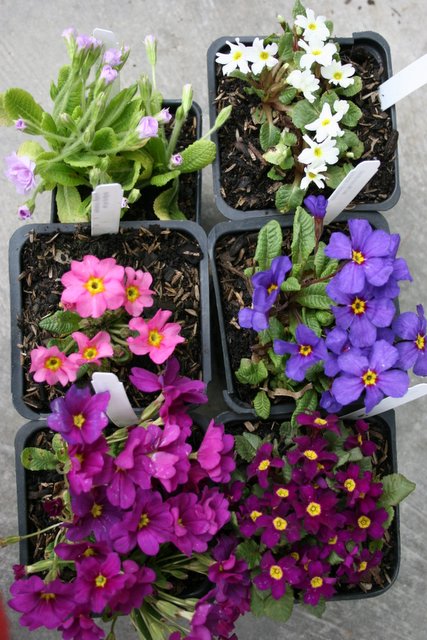 Can there be anything finer than, on a cold, windy day in mid-March, being out in the toasty greenhouse, unpacking the first spring shipment of new plants for the garden? The first order always comes from Arrowhead Alpines in Fowlerville, Michigan. Bob and Brigitta put out a catalogue that is so jam-packed with treasures that the first time I saw it, it gave me the shivers, and I could only read a few pages at a time. Now, many years (and dozens of boxes) later, I can sit down and look through the whole thing at one sitting without hyperventilating at all, but it still is my favorite catalogue, and the source for many of the shade perennials that now grow in our woods, and are pictured on this blog. Of course, as soon as I had the plants all unpacked, I started thinking I should have ordered more primroses... but then I think the same thing EVERY year!
Wednesday, March 15, 2006
Scilla Tubergeniana
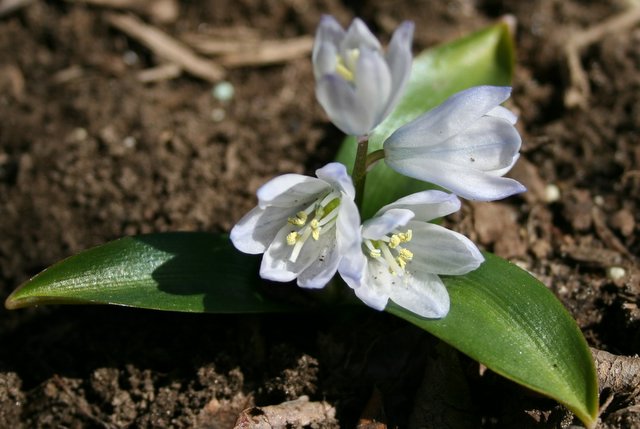 When this little bulb first bloomed in our garden, ten years ago, I mused over what to call its color; an ephemeral mix of white, and clean blue. A couple of years later, we remodeled the living room of our house, and Liz chose a light blue carpet, and wanted the walls painted in white, but with a subtle hint of blue that would mirror the carpet... the paint she chose was called "skycloud", and as soon as I heard the name, I knew that is what I would call the color of this little squill, for it reminds me of those old Dutch landscape paintings by Ruysdael, where the white clouds and the blue sky are all mixed together by the wind. This is the first squill to bloom, beginning right after the snowdrops, and along with crocus and cyclamen coum. When it first starts to bloom, as above, it looks unpromising, as it is in such a hurry to open its blooms for the first bees, that its flowers start opening just as they emerge from the soil, often getting a little dirty in the process. The flower stalks then rapidly rise to about four inches, and are literally crowded with these ravishingly subtle flowers, that are huge for the size of the plant. The actual Latin name is Scilla mischtschekoana, but probably due to the brutality of its given species name, it is commonly called Scilla tubergeniana (Sill-ah too-ber-jin-ee-ah-nah). It is named after the Dutch bulb firm, Van Tubergen, which introduced this little plant to the west in 1931 from its native Persia and the Caucasus. Van Tubergen was founded in 1868, and is still in the bulb business. Scilla tubergeniana has a long bloom time, and is said to tolerate more shade than most other squills. It is hardy in zones 4-8 (possibly even zone 3). It's fragrance is pretty faint, but that doesn't seem to discourage the bees, as I usually have to brush off a bee or two to get a picture. I have a patch of these growing with some early Juliana primroses, in front of a grey boulder, and it's one of my favorite stops in the early spring.