Tuesday, October 31, 2006
Maplehead
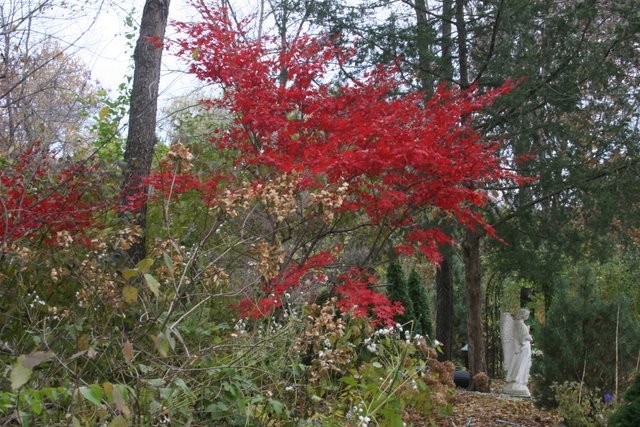
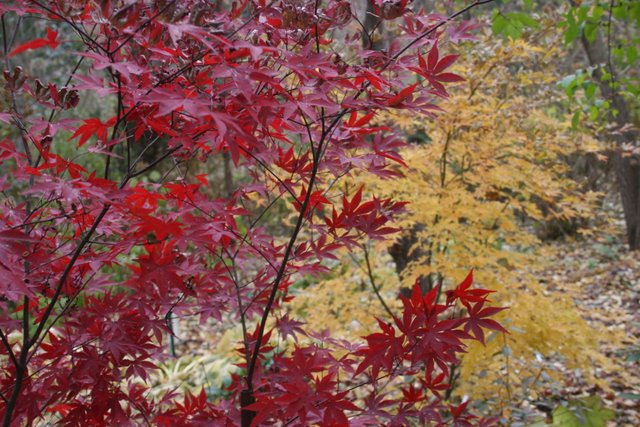
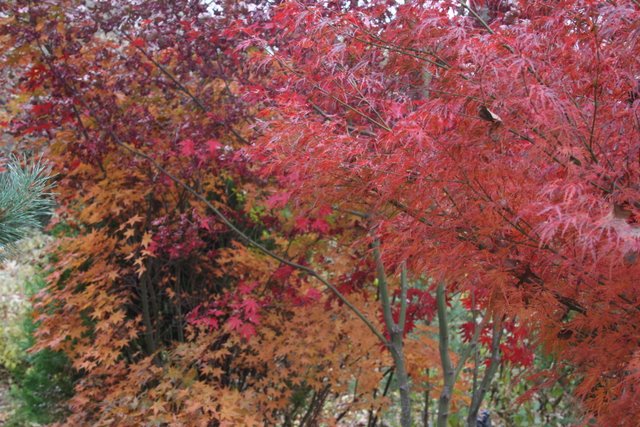
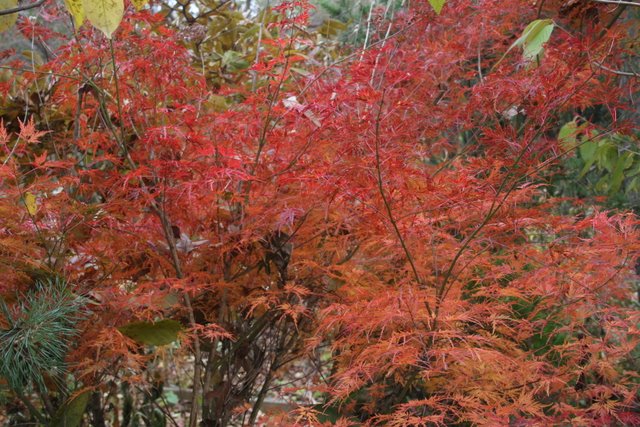
 Japanese maples are insidious; you buy this cute little maple in a one gallon pot and stick it in the garden; the next spring you find two more at the nursery, that are quite different than the one you already have (which looks quite lonely, being still only two foot tall, stuck out in the woods). The next thing you know, you have a whole bunch of them, in all colors and leaf types, and those little cuties are now growing like topsy everywhere. Let's face facts... you've become a maplehead! This fall was far from the best for their foliage, due to the severe early freeze, which occured while the trees were still in full, green leaf. However, here are a few pictures, in no particular order, of some of the Japanese maples in our garden.




Monday, October 30, 2006
Morning
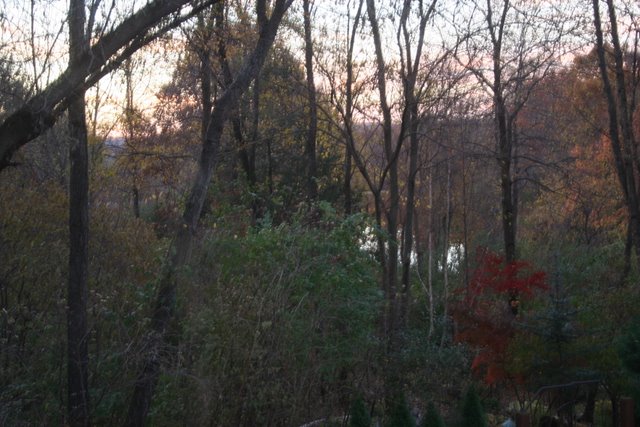 Late fall mornings come hesitantly into our little valley; the sun ever-so-slowly pushes the night down the valley and across the river. When we remodeled our house, we had large floor to celing windows put in our upstairs bedroom (through which, this picture was taken) so we can watch the woods awakening. However, this time of year, I don't stay in bed long once the sun is peeping; there is too much to do outside. It always seems like my list of things that I need to get done before winter arrives, expands at an alarming rate; I feel like a little squirrel, running back and forth faster and faster, as the leaves flutter down from the trees and clatter across the ground, pushed by the cold wind that yesterday was blowing across the snow-streaked North Dakota short grass prairies. Although it seems impossible at this point, I know it will all somehow get done; then a day of unremitting cold and greyness will freeze the ground solid, and my gardening will be done, until the chickadee whistles his soft, sweet song to awaken the woods in earliest spring.
Saturday, October 28, 2006
Eco Gold Spangles
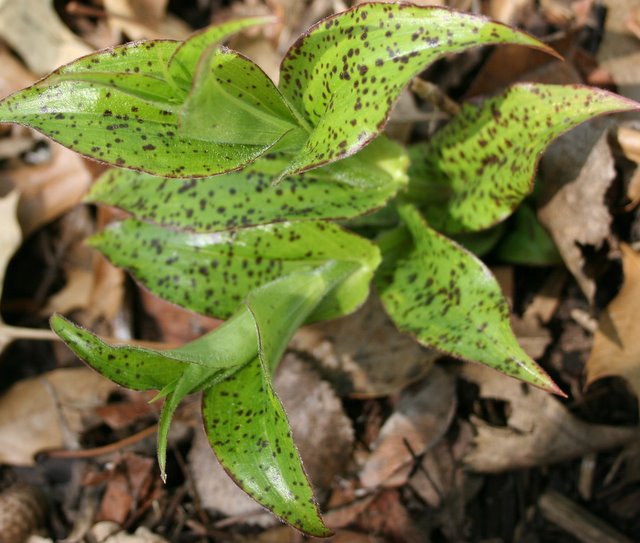 Eco Gold Spangles is a hybrid toad lily, from Don Jacobs of Eco Gardens in Decatur, Georgia. The new foliage in spring is jaw-dropping, and the lemony, spotted flowers, shown below, are quite special. I have this toady planted in the shade of a large oak tree, next to a hosta that has very bright yellow foliage in the spring... hard to ignore.
Friday, October 27, 2006
The Hidden Drought
 On a cool, grey morning after a day of misty rain, I was out to the garden, serenaded by the wild and forelorn call of loons on the pond. They perhaps are lamenting the loss of their dark Ontario lakes until spring. We have had about two inches of rain in the last two weeks, after three months of dry weather. Puddles by the side of the road are a welcome, if unfamiliar sight. Last year, the upper midwest suffered its worst drought since the dust bowl years... we did get some rain last fall, but the stress on the trees was apparent this spring, with many limbs dying back, for example, on the tall black cherry trees in our woods. The rain this year started promisingly, if still a bit below normal for us. Since mid-summer, upper Illinois, which suffered with us in dryness last year, has been deluged with rain, but once again eastern Iowa has been stricken with drought; the welcome rain in the last two weeks has replaced our topsoil moisture, but on digging down, one can see clearly that the top 8-9 inches of soil is wet, but the subsoil is still dry and hard. It's almost like desert caliche; the subsoil has set up like cement from the prolonged drought, so that water has trouble penetrating it... I fear for the tall trees, going into winter with their roots encased in dry cement.
Thursday, October 26, 2006
Affinity For Affinis
 Tricyrtis affinis is a Japanese species of toad lily; it is a bit stiffer and more upright than, for example, the hirta types, and the flowers are more upright as well as up-facing, on longish stems arising at the top of the plant. That being said, I think the affinis clones are grown as much for the foliage (which can be strikingly patterned) as for the flowers, which are small, and a little sparse. Lunar Landing, below, and Key Lime Pie, above, hint at the variety available.
 Wednesday, October 25, 2006
Further Foliage
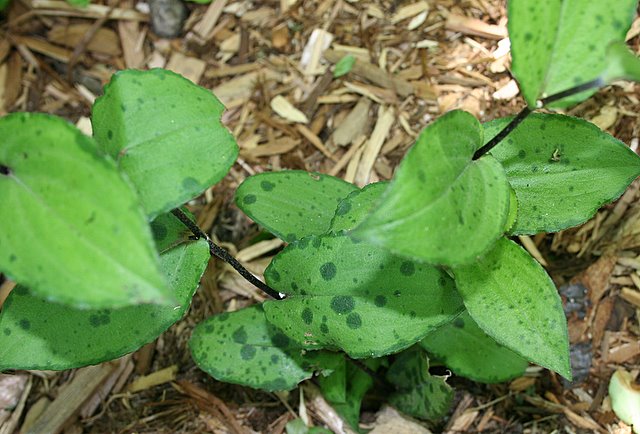 Now, if you want striking, in toad lily foliage; this is Tricyrtis affinis 'Lunar Landing', with bright green leaves edged in darker green with even darker green spots, and purplish-black stems.
 Tuesday, October 24, 2006
Foliage Followup
 A few days ago, when I posted a picture of the late fall blooming of Tricyrtis Lemon Twist, I mentioned its striking, waxy, spotted foliage in the spring. I lamented that I had no picture to show of its foliage, but I guess I should have checked my picture files before saying that: here it was in April. It looks rather like one of the spotted foliage species of erythronium (dog tooth violet).
 Workhorse Toady
 Over the years, I've added a lot of fancy-dancy toad lilies to the garden; some are indeed nice, some looked nice in the catalogue but don't like our hot, dry summers, so the leaves burn, and a few of them took one look at an Iowa summer and disappeared forever. I certainly enjoy looking at all of them (well, maybe not the bare spots, if they died on me), but if I just want a whole bunch of toadiness, I go back to the first tricyrtis I ever bought: Tricyrtis hirta variegata. I've gradually split up the original plant, and everyplace in the garden I've stuck it, it's taken off; it's one of those plants which look quite refined, but when you're not looking, it mugs the plants next to it, so you suddenly wonder where your prized primrose went. Its now got its sights set on taking over one of my pathways... we'll see about that!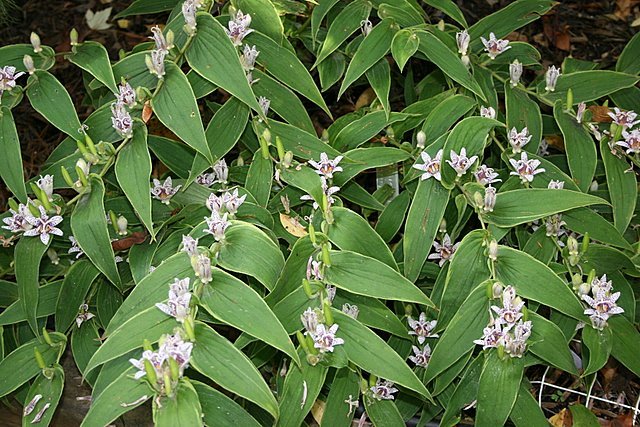
Monday, October 23, 2006
Something Different: Tricyrtis X Tojen
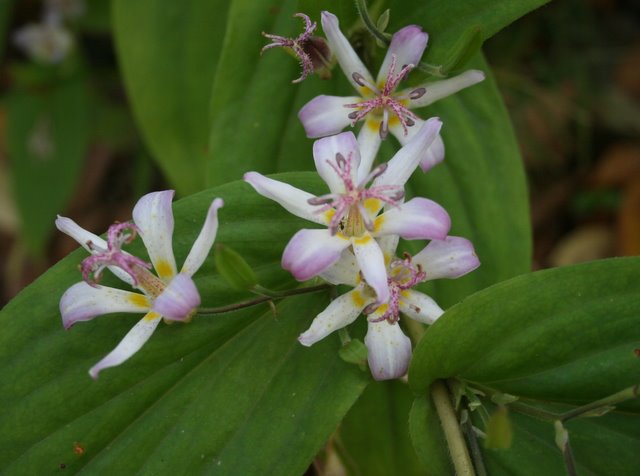 On a cold, grey morning, it is almost dizzying going outside; the yard and woods are literally alive with birds, driven south all in a rush by seriously cold temperatures to our north. Hundreds of small birds... warblers, finches, and white-throated sparrows mostly, are whirring through the treetops; scores of robins and juncos are scurrying back and forth across the lawn, while jays, woodpeckers, and cardinals fly back and forth, as if caught up in the excitement. I negotiate my way across the lawn, feeling like a sheepherder, as birds hop this way and that, parting to let me through; in the garden, leaves that were frozen while they were still green by our early cold, are falling to the ground from the trees, almost with a clunk. Yet I am rewarded on this cold morning by finding Tricyrtis x Tojen (also spelled Togen) still in bloom. This tough toadie has one of the most lengthy blooming seasons of all the tricyrtis group. It starts opening its flowers in late August or early September, and continues blooming until finally felled by a really hard freeze in late October... it tolerates light frosts and freezes fairly well, only succumbing to temperatures in the low twenties. Of course this lengthy blooming season means that it opens its flowers gradually, not all at once, so the total effect is not as spectacular as some, but the individual flowers, arising on long stems from the axils, are quite beautiful. It is often called the "orchid toad lily", for the exotic beauty and color of its individual blooms, which are frosty lavender at the base of the petals, deep lavender at the tips, with a yellow throat. The foliage may be the finest of any toad lily, with the largest leaves; they are very broadly lance-shaped, and a lighter, brighter green than most other tricyrtis. The plant has a slightly drooping habit, so I have it planted to good effect on a downhill pathway, where its flowers are easily seen. It is apparently a hybrid of formosana x hirta; some of the formosana group in our climate barely persist (Emperor), and a few have disappeared (Samurai); I'm not sure whether it's our cold winters or our dry summers, or both. Tojen, however, always looks perfect, with no help at all from me.
 Sunday, October 22, 2006
A Spotty Reputation
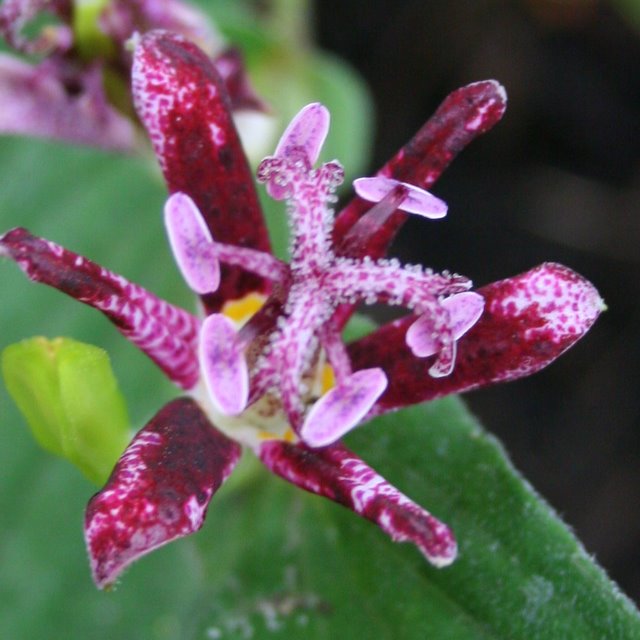 Toad Lilies are best known for their fascinating, spotty flowers, but apparently the continuing search for new commercial varieties with heavier spotting, has led us down a risky pathway. Chris Hallson, of Hallson's Gardens has discovered that some of the newest, most popular toad lilies owe their coloration to a virus, which causes not symmetrical spots, but rather blotches of color to infuse the petals. Alas, 'Rasberry Mousse', shown above, perhaps the most strikingly colored of toadies, is the poster child for this virus (which can be transmitted to other toad lilies in the garden). Two other varieties thought to be infected, are 'Blue Wonder', shown below, which in its first year in our garden doesn't seem to show much blotching, and 'Empress', at the bottom, which is definitely blotched. How easily the virus can be transmitted, and which other varieties are susceptible, has not been discovered yet; also it's not known how harmful the virus really is; is it just a curiosity, or will the infected toad lilies eventually croak...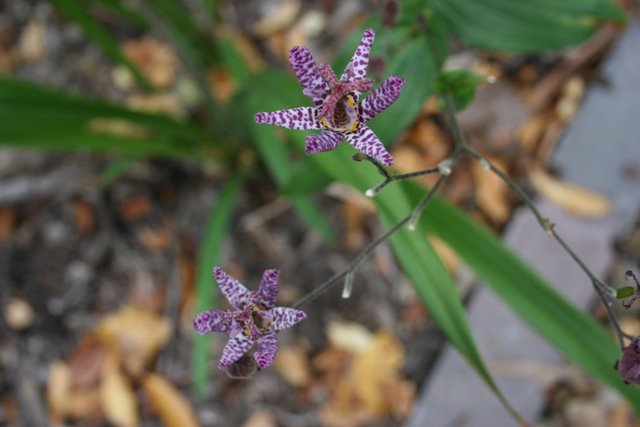

Saturday, October 21, 2006
Weather Vagaries
 October is normally our most beautiful month; a time of endlessly blue skies, and bright sunshine... well, this October has not been normal. It's been the moldy strawberry at the bottom of the basket; a month of clouds and more clouds, and almost unremitting cold... the coldest, cloudiest October since skinny ties and Hula Hoops were in vogue. What's worse, is that global warming is to blame; that, and something called the North Atlantic Oscillation (N.A.O.). It seems that in winter, a warm high pressure bubble sometimes builds up over the North Atlantic. This area of warm air oscillates between Greenland and northern Europe... it currently has been stuck in the former position, and is very powerful due to global warming. When the N.O.A. is over Greenland, it blocks the circumpolar jet stream, which normally circles the globe in the far north, and causes it to buckle down over the central U.S., dumping all the cold air on you-know-who's little garden. Since all of the frigid air is in our backyard, apparently Alaska has been downright balmy; they're also getting all of our rain. With all our gloomy weather, the birds just sit around and look at each other, and even our little cat P.J., normally as cheerful a little soul as you could ever hope to meet, is moping about like she just found out they stopped making crab flavored Whisker Lickin's. Well, someday the sun will shine again, someday flowers will bloom and the birds will sing... just not this month.
 Friday, October 20, 2006
Toad Love
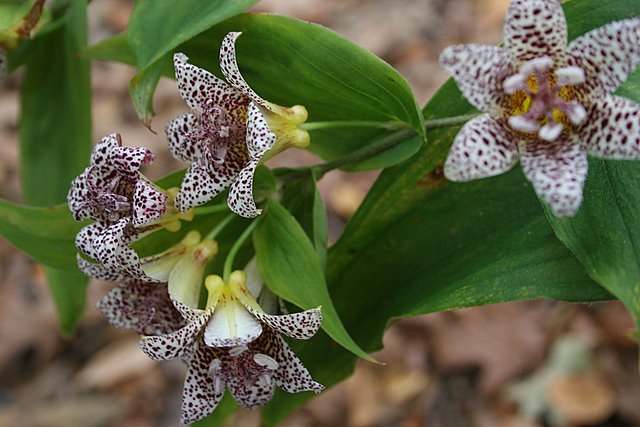 I love all toad lilies, but which do I love best? I suppose that the choice is so subtle, that as often as not, the one I like best is the one that I'm looking at now... but I can, I think, without too much pondering tell you which tricyrtis has the best flower... it's Tricyrtis Kohaku. It was bred in Japan as a cutting flower, and what flowers they are! They're very big, with thick substance (almost porcealin-like), and have numerous large maroon spots and a lemon-yellow throat, with the yellow color also infusing the backs of the petals. Notice I said it has the best flower; I'm not sure it's the best overall plant. It's a cross between hirta and macranthopsis, and has inherited the floppiness of the latter, especially a problem with the great number of heavy blooms. This is one of those plants that they're always telling you, looks smashing trailing over a stone wall... well, my garden is a little short on weathered stone walls, and that wobbly white plastic fencing just doesn't have the same effect. Anyway, look closely at the individual flowers of Kohaku, and all is forgiven.
 Thursday, October 19, 2006
Steal This Blog
Kathy, on Cold Climate Gardening, has a new piece discussing the theft of blog content (pictures and text); it is being hijacked for use by other nefarious websites. This raises a very puzzling and vexing issue; though I've not actively looked into it, to my knowledge, nobody has EVER stolen anything from this blog. God knows it would be easy enough: the door is always ajar, and the owner is usually outside, peering into a bush or something. I suppose it wouldn't do any good if I did find out parts of my blog were being usurped; as I understand it, the laws governing this area refer to theft of intellectual property, and I doubt my blog falls under that umbrella.
Wednesday, October 18, 2006
Fuzzy Wuzzy
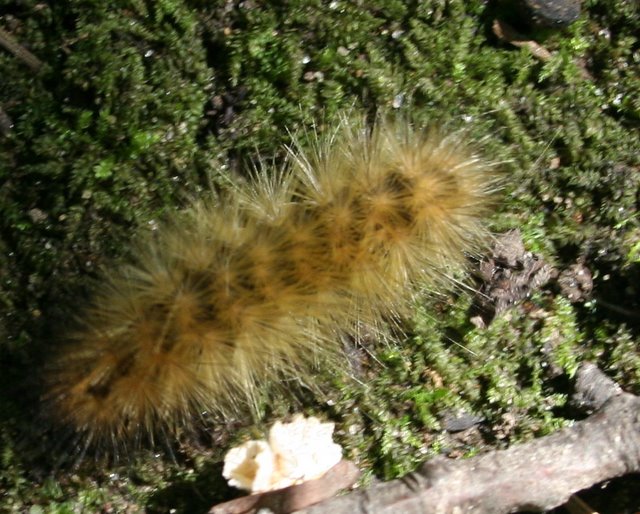 In the garden today I spied this little fuzzy,
I think he was crawling to the right... or was he?
A Cloudy Day
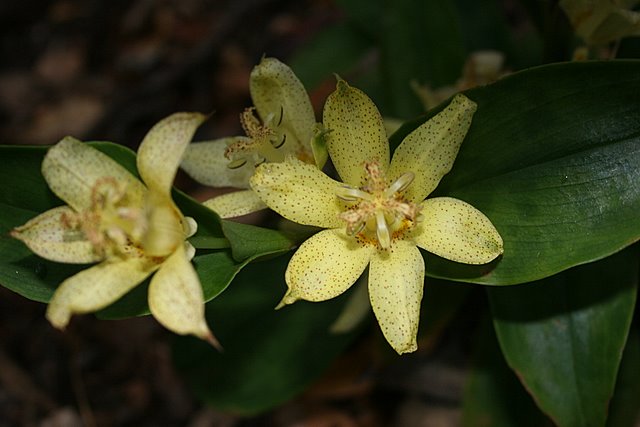 It is a day of sharp adjustment; yesterday we were in southern Arkansas, with roses in full bloom, and the leaves just starting to turn... today, here in Iowa, the leaves are in tatters, a cold drizzle is falling, and the garden is rapidly getting the late autumn floppy-mushies. However, a wet walk up and down the garden paths shows plenty to look at. In particular, many of the toad lilies are still bravely carrying on, as if winter was far away; this is Tricyrtis 'Lemon Twist', a cross between the two dwarf species, ohsumiense and flava. It is at most a foot tall, and in the spring has some of the finest foliage in the garden, with very thick, waxy, deep green leaves with large, dark spots. In the late fall, it has yellow flowers with speckles... a small spot of sun on a gloomy day. We're back.