Monday, February 27, 2006
Marching Snowdrops
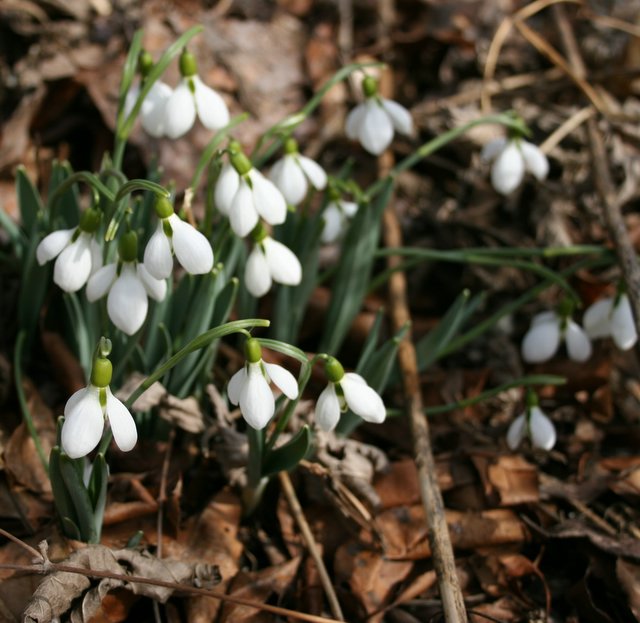 After a relatively mild January, we've had a brutal February; not in terms of snow (there hasn't been much), but in terms of near-record cold. Today, as February wanes, and March is in the wings, the sun finally broke out, and it warmed up. As I walked through the still almost barren garden, one got the feeling the woods and garden have just awakened from a long, deep sleep, and had just stumbled out into the bright sunlight, not knowing yet what to make of it, or just what was happening. The cardinals and titmice were starting to sing off in the woods, but were still tentative, not yet having their hearts in it. Somehow, the greater snowdrops (Galanthus elwesii) have largely remained in bloom, their flowers just a little worse for the wear. When the temperatures drop down severely, the snowdrops lay their flowers down on the ground, somewhat protected by the spathe. When the weather finally warms, and the sun comes out, they stand up again, but never quite as straightly as before; it has been said that they look a little stoop-shouldered. The few hardy honey bees that are out buzzing about are happy to see the snowdrops, as they are the only flowers out, so they get quite a going-over. It is supposed to be 60 degrees with a chance of rain on the first of March... the flower bulbs and I will have trouble sleeping the next few nights.

Sunday, February 26, 2006
Seeing
I climbed to the top of the red cedar tree,
really not sure just what I wanted to see.
A bright azure sky filled the valley with light,
while a stiffening wind sent the clouds in flight.
The pond below was clear, and quite deep,
for it's here the fresh springs bubble and seep,
melting the ice where these warm waters run,
so the pond sparkles, in the wind and the sun.
Then just when I thought I'd seen what I could,
a red-shouldered hawk flew out of the far wood.
I leaned out to see him, as he glided slowly by,
and then picking up speed, he gave a shrill cry.
The wildness of his call would make rabbits shiver,
but the hawk flew on, and down towards the river.
Sticky with sap, I climbed back to the ground,
and admired the acorn, our young cat had found.
The cat and I, both like to explore and to roam,
but now we just headed back towards our home.
_______________________________don
really not sure just what I wanted to see.
A bright azure sky filled the valley with light,
while a stiffening wind sent the clouds in flight.
The pond below was clear, and quite deep,
for it's here the fresh springs bubble and seep,
melting the ice where these warm waters run,
so the pond sparkles, in the wind and the sun.
Then just when I thought I'd seen what I could,
a red-shouldered hawk flew out of the far wood.
I leaned out to see him, as he glided slowly by,
and then picking up speed, he gave a shrill cry.
The wildness of his call would make rabbits shiver,
but the hawk flew on, and down towards the river.
Sticky with sap, I climbed back to the ground,
and admired the acorn, our young cat had found.
The cat and I, both like to explore and to roam,
but now we just headed back towards our home.
_______________________________don
Saturday, February 25, 2006
Primula acaulis
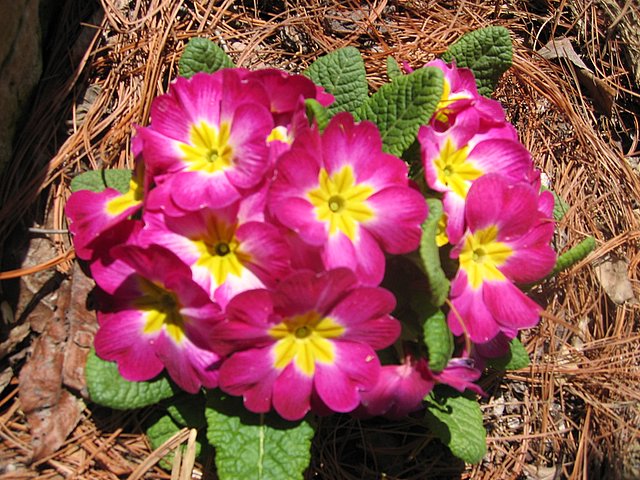 Writing recently about the daintier little primroses, perhaps I made it sound like I was sniffing at the large-flowered hybrids... I wasn't.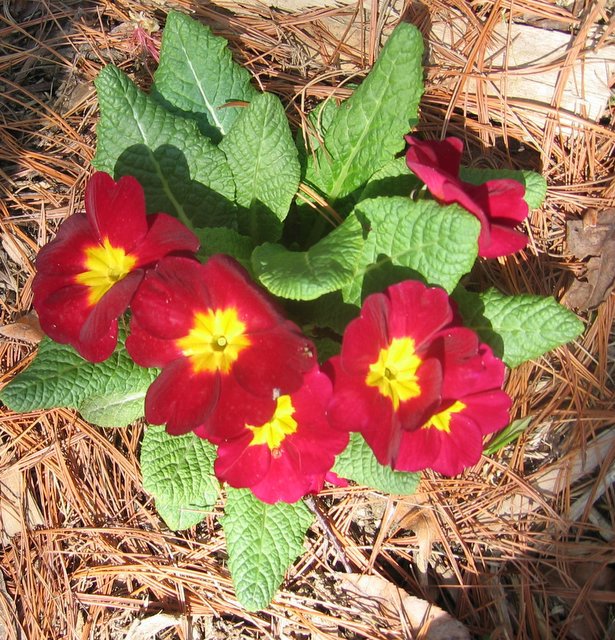

Friday, February 24, 2006
Erythronium

Wednesday, February 22, 2006
Primula Juliana
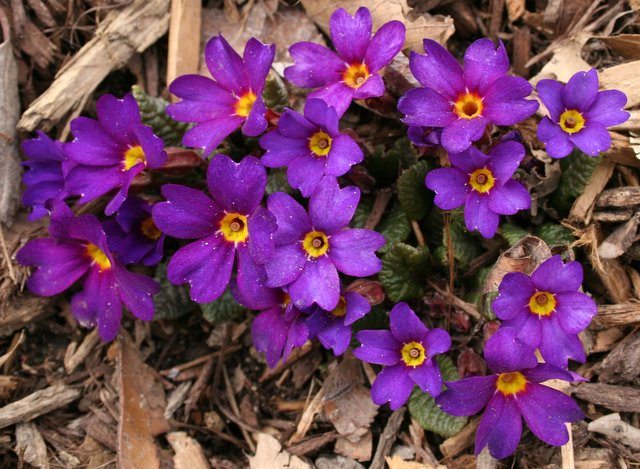 The last of our miniature garden primroses is really the first; first in bloom (these pictures were taken last March) and first in my heart.This really is a group of hybrids, which go by various names... juliana, juliae, pruhonica, Wanda... it is confusing, because at first you think you are dealing with a distinct species, but they are mostly hybrids. We grow quite a variety of them, and later this spring I hope to write more in depth about them, with more pictures, and to outline what I understand about the classification of them. For now, I will just say they are tiny to small early bloomers, rock hardy for the most part, and are covered with flowers in breathtaking colors.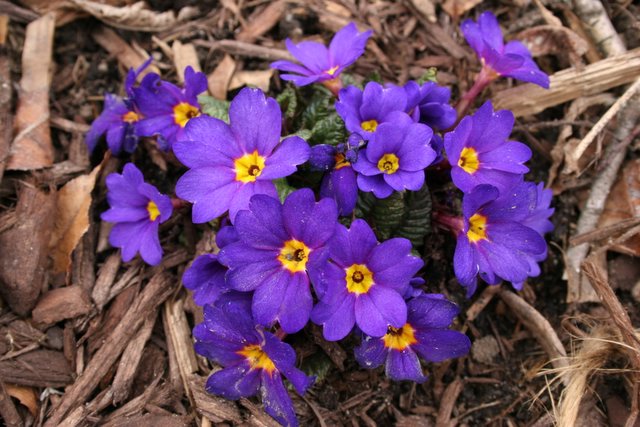
Tuesday, February 21, 2006
Primula yuparensis
 We continue down the small primrose path with Primula yuparensis, which grows naturally in only one spot in the world, on Mt. Yubari in Japan. I am amazed this little primrose is not more widely known and grown; it looks much more at home in a woodland garden than the gaudy commercial primrose hybrids, which tend to look like you just popped them out of a pot. Yuparensis stays in bloom a long time, and its blooms die more gracefully than the vulgaris hybrids. I have it growing on a north-facing slope in a small, shady ravine, right next to some wood steps leading down to a bridge, where I can see this miniature plant blooming in the spring; the picture above was taken last April 15th. The only negative for yuparensis, is that if you get your nose right down into the flowers, it has a faint smell of urine (We do have cats, but they denied going anywhere near it).
 Monday, February 20, 2006
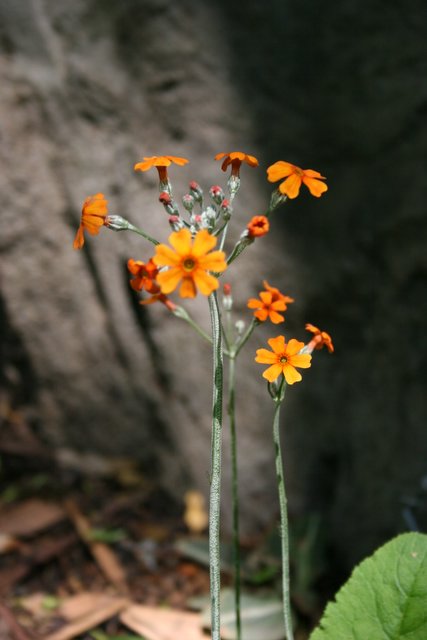
Primula cockburniana
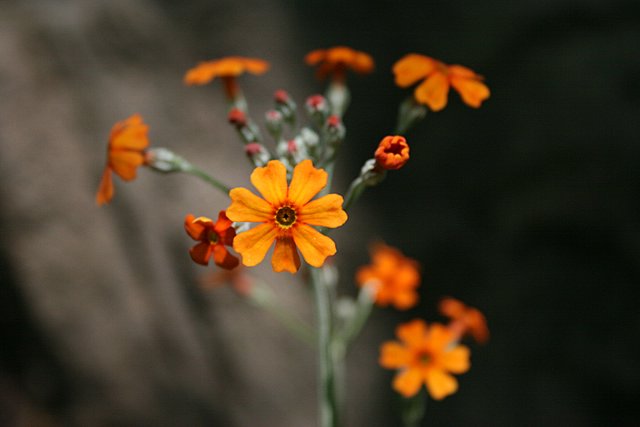 The next miniature primrose that grows in our garden might well push itself to the head of the list, rather than being buried in the middle, just by merit of its rich orange color, so unusual in small primroses, with the usual palette of purple-mauve-pink-white. This primrose is native to mountain meadows in western China, but is happy here amongst the cornfields in a peaty, well-drained spot in a shady ravine, where shafts of sunlight occasionally light up its burnt orange flowers. It stays in bloom an unusually long time for a late spring-blooming primrose (the pictures here were taken in mid-May). It is said to sometimes be short-lived, but will re-seed... I've only had it a few years, and it seems to be clumping up, but I plan on collecting some seeds this year.
Sunday, February 19, 2006
Primula frondosa
 Miniature primroses are to me like precious gems scattered on the forest floor; it is not an exaggeration to say that I am thrilled each time I find one of these little plants in bloom in spring or early summer, perhaps nestled in front of a grey boulder, or concealed next to an old moss covered stump in a shady ravine. Primula frondosa, shown above, might be the most perfect little primrose that I grow. I show it and extoll it with reservations, as I would say it persists in our garden rather than fluorishes... our hot, dry summers are a challenge for it, not exactly emulating its native haunts in the mountains of Bulgaria. This is one of the so called "birds-eye" primroses, which you can easily appreciate on its flowers, and it is in the group of farinose primroses; that is its leaves have a light covering of farina, a whitish powder. Farinose primroses in general like Scotland much better than Iowa, but I have had P. frondosa for three years now, so it may be a survivor.
Friday, February 17, 2006
The Gentle Winds
The temperature here at the first of the week reached 65 degrees, and tonight is predicted to be 8 below... a drop of 73 degrees in 5 days. It is a wonder we can grow anything other than annuals.
Primula rosea
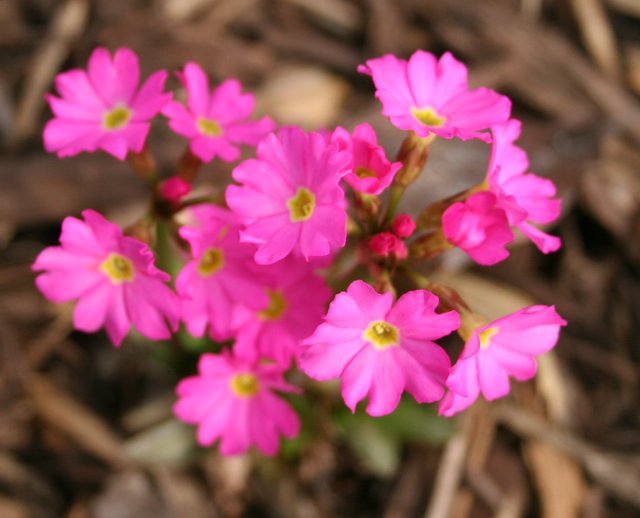 It is no secret on this blog that my first gardening love is small woodland plants. One of the best of these is Primula rosea, a diminutive primrose native to the Himalayas, so it likes a moist, cool, shady, but well-drained spot in the garden (the shady part is about all it gets around here, but after its initial astonishment at the predicament it now finds itself in, the plant has settled in). It blooms very early, the picture above being taken last April 6th. It actually begins blooming even before the leaves fully emerge, which you can kind of appreciate in the picture above. As soon as the weather turns hot, its flowers begin to decline, but with luck it is in bloom for a month. The picture below, taken two weeks later, shows the small, clumping leaves, with the flowers already starting to fade. Its flowers are pristine, as if made of crystal, and a hot pink, which is very striking when it begins its bloom arising from a still essentially bare spot of ground.
Here Bossy
I remember, as a child, visiting the farm of my uncle George, and watching him call in the dairy cattle.He would open up the gate leading to a long dirt pathway that stretched a quarter of a mile between corn fields, calling: "Here Boss, here Bossy!" and then after a few moments you'd hear a cow bell clanking off in the distance, and the lead cow, followed by all the others, would come ambling up the lane, through the gate, and head to the barn. Not too long ago in one of those unaccountable moments of mental musing, I started wondering why farmers call their cows "Bossy". Googling in "Bossy" got me some interesting porn sites, but no closer to an answer. Then recently it dawned on me... the genus for cows is Bos taurus... duh! Apparently Bos is the Roman word for cow. Other fun cow facts that city folks may not know: a heifer is a cow that has not yet had calves, and a dogie (or doggie) is a motherless calf (as in "Whoopee ti yi yo, get along little dogies, it's your misfortune, and none of my own. Whoopee ti yi yo, get along little dogies, you know that Wyoming will be your new home.")
Thursday, February 16, 2006
The Wee Landscaper
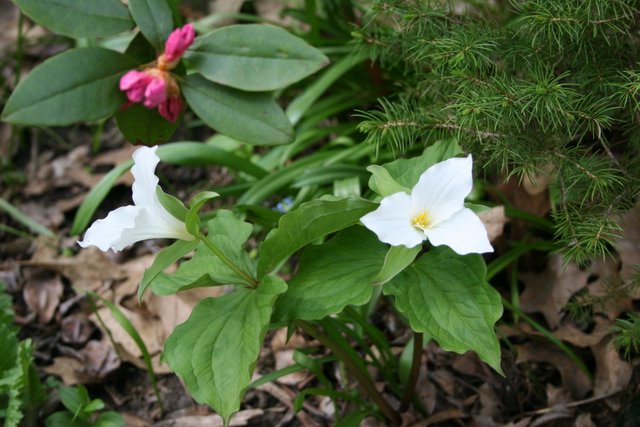
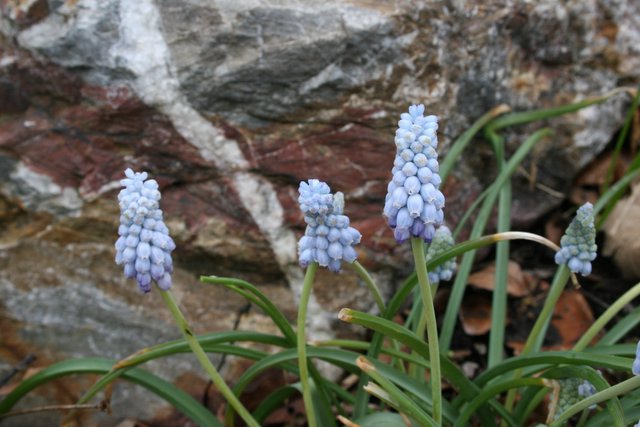 I was probably feeling a bit sorry for myself in a recent post, bemoaning the fact that my garden seems largely bereft of dynamite combos of shrubs and large flowers that would look good on the cover of Fine Gardening magazine. However, as the sleet and snow blow past my window, I've been looking again at some garden pictures from last spring, and started realizing that the garden DOES have some nice spots of landscaping with combinations of plants, but they aren't immediately visible, as they are landscapes in miniature; for these small woodland perennials and bulbs are my first love, rather than the larger plants so dear to the heart of garden photographers. I've always joked that our garden is best seen on hands and knees... perhaps I should trench out the paths.



Tuesday, February 14, 2006
Ah, Spring!
Well, today it is to be a warm hazy 65 degrees here, but a huge, powerful high pressure area of intense cold is drifting south over Montana, which will create gusty southern winds over the lower midwest, and result later in the week in a temperature difference of 100 (yes, 100) degrees between the upper and lower midwest. The southern wind is going to hit a band of easterly wind over us, lift the moisture, clash it with the frigid arctic air coming south, and probably bury us in snow. Our temperature here will drop from 65 above to 1 below in about 60 hours; a drop of 66 degrees! Ah, spring in Iowa!
Crocus Focus
 I've been perusing E.A. Bowles' Handbook of Crocus and Colchicum. I say perusing, as it's too dense to read; I've got his revised edition of 1954, written 30 years after the first edition, filled with a lifetime of knowledge from the man who surely knew more about small bulbs than anyone else. I've got only a few crocuses (like the little blue, un-named charmer above) in our garden, as it's too shady and there is too much competition, but a couple of minor mysteries that I'd run into in growing these little bulbs were cleared up by this book. First of all, from time to time I'd notice the foliage of a crocus laying on the ground all by itself. In his book, Mr. Bowles states that was a common occurence in his garden, and he attributes it to birds pulling out the whole plant by its leaves, eating the bulb, and leaving the foliage... now, he mentions chaffinches as one of the culprits, and I've not noticed any of these little English finches hopping about on the greensward, but he states that sparrows are also guilty, and THESE we've got. In fact, of course, our house sparrow's ancestors were probably pulling up crocus bulbs in England not too long ago. I was also quite interested reading about the saffron crocus, C. sativus. In reality, Bowles states, this is probably not a true species, but rather a garden bulb that was one of the very first cultivated flowers. It may be a selected form of C. orsinii, which grows wild in Italy. In our garden, I've noticed that its pale lilac flowers with their bright orange stigmata appear faithfully, like little ghosts, every October for a few years, then the plants slowly fade away... I had them planted under a creeping sedum, which gave a very pleasing effect. Bowles states that the saffron crocus really needs a bright, sunny spot with no competition, and must be lifted and divided at least every three years, or it will stop blooming, and die. Since mine were lifted like... well, never, I guess that answers that. I must find them a spot of their own.
Monday, February 13, 2006
The Indiscriminate Gardener
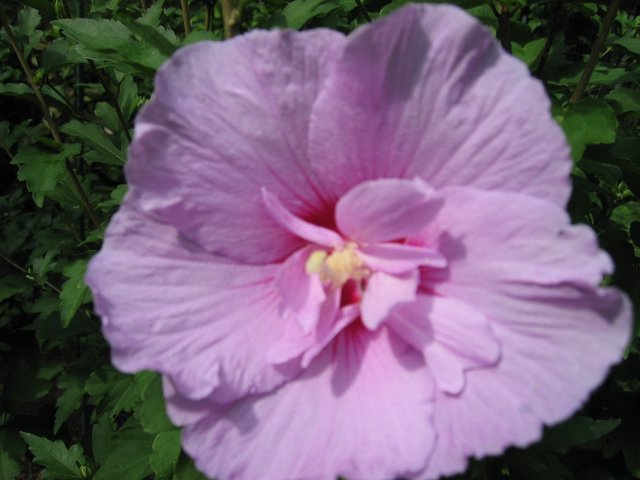 Our friend Laura is a city girl, with a city yard, but it is filled to bursting with plants that almost shine with care, and she knows each and every one of her plants, and they are all there because she chose them and likes them. Her plants respond to this attention, and fairly quiver with vitality. There are people (well, quite a few folks actually) who think that I, on the other hand, just buy one of everything for my garden, and let the plants fight it out. Once, at a party Laura asked me if there was any plant that I didn't like (afterwards I started wondering if she was asking a question, or more making a statement; did she say "Is there any plant YOU don't like?" or did she say "Is there ANY plant you don't like!" Be that as it may, I do recall that I almost came up blank, finally offering that I don't care for double flowered Rose of Sharons, as their flowers, when they are over the hill, look like wet toilet paper hanging on the bush, especially if it rains. I of course had to then admit that I was crazy about single flowered Rose of Sharons, and even semi-doubles like Lilac Chiffon shown above, and that I consider these to be the single most under-utilized flowering shrubs in the midwest. I am especially enamored of their season of bloom, in late summer, when the other flowering shrubs are snoozing in the heat. Since that party, I've thought some more and have come up with one more plant I won't grow: forsythias. I must admit that my dislike stems not from any problem with the plant itself, but chiefly from the fact that in cold winters most of them lose their flower buds above the snow line here, so they look like a drab dowager with a bright yellow petticoat. I'm also not fond of the way everybody around here trims them into an ugly bun shape. At any rate, I've now doubled the number of plants I don't like... call me picky!
Saturday, February 11, 2006
The Random Gardener
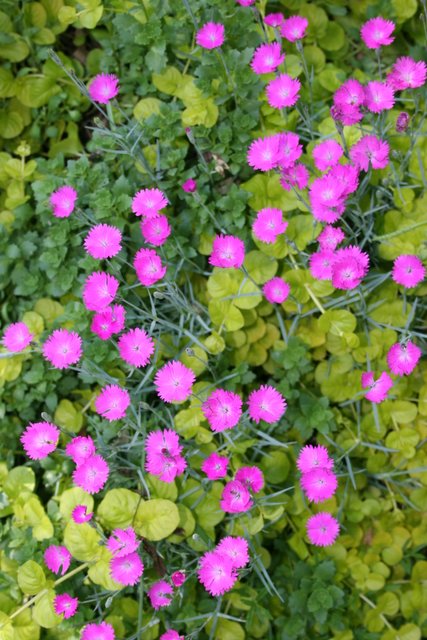
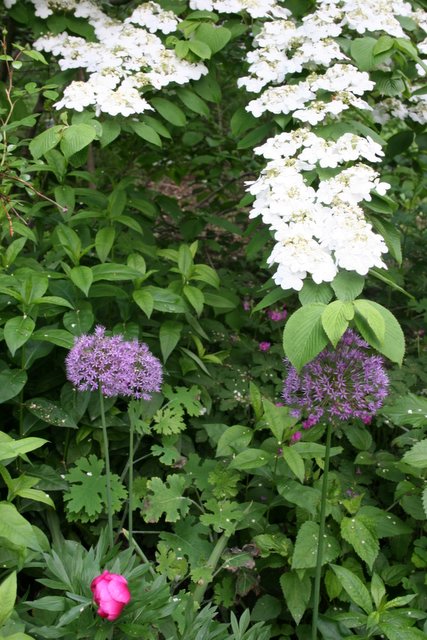
 This last gardening year, I showed quite a number of pictures of individual plants, and talked about how they fit into our wooded garden. After a while I started getting requests for pictures that showed the overall garden, and finally cobbled together a visual garden tour, which really mainly showed the garden paths more than the beds, explaining that it was hard to show any sense of the overall garden in a small picture, as the flowers are embedded in a woods, with pathways that meander around, precluding any impressive distant shots; I do very much like the garden walk as one of discovery. But I also have a dirty little gardening secret: I am a terrible landscaper, largely devoid of whatever talent it is that allows people to stand back and visualize the beauty that will result in combining plants, and lacking in the patience that it would take to accomplish a pleasing effect. Once in a while, even in my garden, on a modest scale as shown in these pictures, plants come together nicely, but that's a tribute to nature's beauty and forgivness rather than anything I did, for I am a plant collector; an accumulator... I am my uncle Hank.... he started out as a stamp collector, branched out into collecting beer cans, and then became a hoarder. By the time he died, his house had little pathways through the rooms between the piles of stuff. Now if you'll forgive me, I have some spring plant catalogues to go look through.