Sunday, April 30, 2006
Fritillaria involucrata

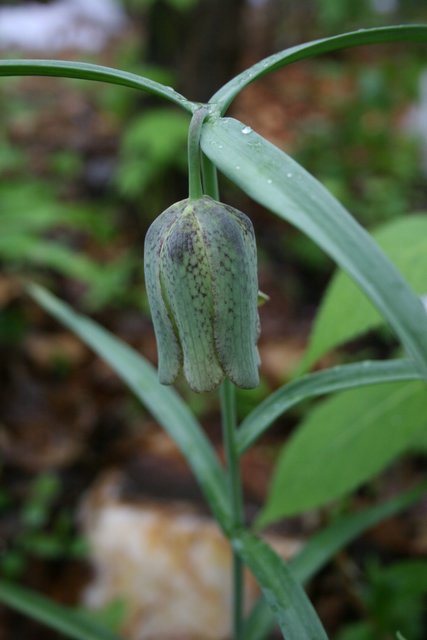
Fritillaria involucrata is native to southern France, but does nicely here on a slightly dry slope, with its cool, lime green flowers, spotted with chocolate.

Easy Stars Of The Garden
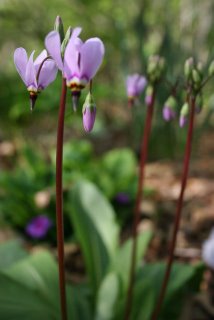
Many of the shooting stars are alpines, and most are not fond of our hot summers here. Three easy ones, though are Dodecatheon meadia, our native prairie shooting star, which blooms a little later, and the two currently blooming that are pictured here. Above is Dodecatheon pulchellum, the dark throated shooting star, found mainly in the western U.S. (so, often called western shooting star), but it is found in scattered fashion to the eastern U.S.

Dodecatheon jeffreyi, endemic to high meadows of the northwest U.S., is also called Jeffrey's shooting star, high mountain shooting star, and Sierra shooting star.
Trillium Fever

What could be better on a rainy day, than poking around the garden looking at trilliums? This is Trillium vaseyi, the sweet wakerobin, with recurved, maroon red petals.

Trillium simile is very striking, with sharply cut white flowers with a black center. It is scented, and often called the sweet white wakerobin, or jewelled wakerobin; it's one of my favorites.

Trillium sulcatum can have flowers ranging from maroon to yellow, to white.

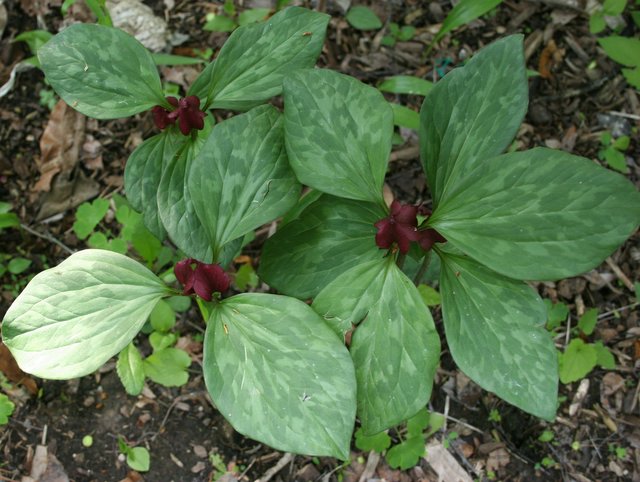
This is Trillium recurvatum, our beloved prairie trillium, with deep red flowers and spotted leaves. These are scattered through our woods, and the steepest ravine has a good colony of these near a small stream trickling down the bottom, growing with bluebells, jack in the pulpits, and Trillium grandiflorum.

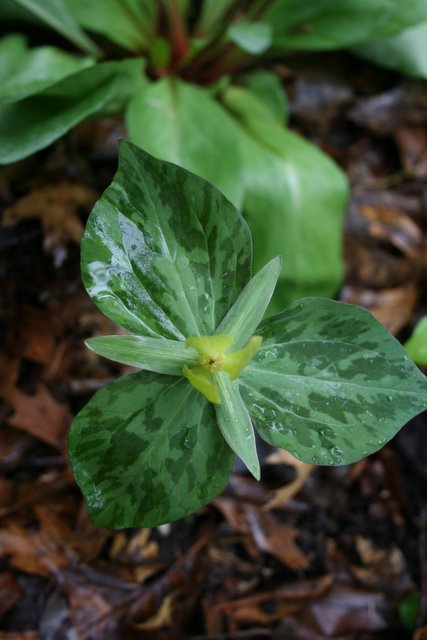
A seedling Trillium luteum, popping up next to a shooting star. The yellow trillium gets quite large, and is fragrant, with nicely spotted leaves.
Saturday, April 29, 2006
Foliage Trio

Fall may be the big season for foliage color, but sunny spring days can be nice, too... this is Heuchera Peach Flambe.

Maple Autumn Moon.

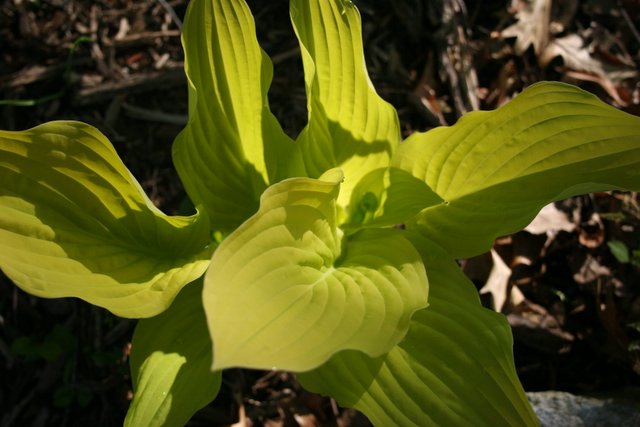
Hosta Granary Gold.
Friday, April 28, 2006
Fritillaria acmopetala

Fritillaria acmopetala might be the overall most satisfactory fritillary; it is tall, elegant, with waxy, exotic flowers that are long-lasting, and every bulb is surrounded by babies. If you like fritillaries (and who doesn't) this bulb is for you.
Lepidote Rhododendrons: Blue And Otherwise.
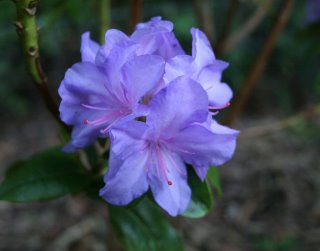
Rhein's Luna, pictured above is a new addition to the garden this spring. It is lavender blue, but my camera seems to like the color blue and has made it look more blue than it really is. It's still beautiful, and I have some hope for its long-term survival, but I don't get too attached to blue rhododendrons until they've at least seen their first Iowa summer and winter. Blue lepidotes apparently mainly get their color from the Rhododendron Subsection lapponica, a group of sub-alpine and sub-arctic small shrubs, that may tolerate winter (or may not, if no snow cover, which is often the case here), and dislike or hate hot weather. R. augustinii gives the best blue, but it turns up its toes here in the midwest, as do most of its direct progeny. Another lapponica, R. russatum, imparts a more purple blue, but is a little hardier parent, and russatum crossed with augustinii (thus russautinii) is half-way in between in both color and hardiness. If russautinii is crossed with a very hardy parent, it has some chance of survival here, and may give lavender blue flowers. Rhein's luna is russautinii X minus Carolinianum, so I have hopes. Bluenose, which I'll show later, when it blooms, is quite hardy here (russautinii X dauricum) but is prone to bark split on the trunk if winter sun hits it. It is a real beauty, a lighter lavender blue, and I love it dearly, and always ooh and ah every spring when it blooms next to a baby pink rhody.
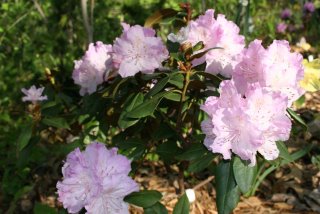
I recently showed a single truss of Rhododendron Hindsight; this just shows the plant better. It's a lepidote that almost looks like an elepidote, with its larger leaves, that it gets from its minus Carolinianum parent, and larger flower trusses than most lepidotes. The flowers are a nice, light baby pink.

Rhododendron Shorty has a nice, bright pink color, with subtly deeper colored spots in its throat, and nice trusses for a lepidote.
Thursday, April 27, 2006
Primula sieboldii

Primula sieboldii certainly has a lot of pluses for a gardener in the land of corn... not the least of which is its hardiness; by dint of having its foliage die back in the late, hot summer, it tolerates drought and heat better than its alpine brethren, and its foliage remains underground until moderately late in the spring, thus also avoiding winter, and then severe early spring freezes. Sieboldii's foliage therefore always looks very crisp and lettucy, offsetting its delicate flowers nicely. It's never quite been a WOW type of primrose for me, though: it doesn't form tight clumps, preferring to meander about loosely, and its pale pink-lavender flowers are sort of delicate and scattered. I may be changing my mind though; a couple of years ago I picked up a purple form of sieboldii...
Monday, April 24, 2006
You Can't Have Too Many Daffodils...
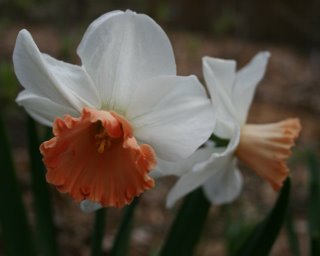
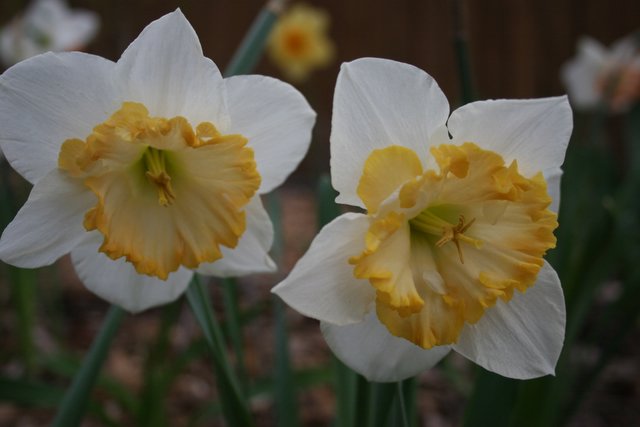
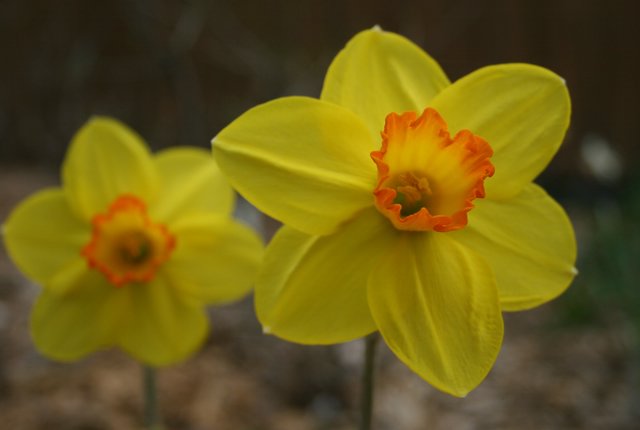
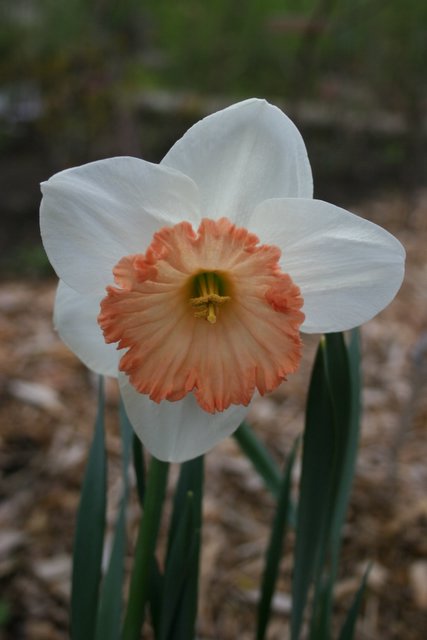
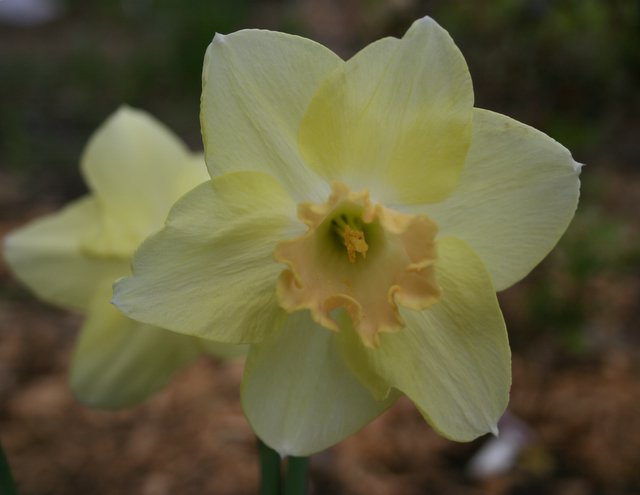
You can't have too many daffodils... or can you? I suppose there are ten thousand daffodils in our garden. Now mind you, I didn't set out to have that many, but daffodils are the rabbits of the bulb world; after a few years, you've got them coming out of your ears. That in itself isn't a problem... I never met a daffodil I didn't like. The problem is that I've been living on borrowed time with my daffodils; you plant one bulb, and soon you've got nice clumps everywhere, with flowers uphill and down, their bright little faces shining in the spring sunshine. Eventually though, those clumps become crowded masses of bulbs, and the blooming rapidly goes downhill. I've done some minor redigging the last few years, but other important jobs, like keeping an eye on the local birdlife, and zipping out on the lake in our boat, always seem to come along just when I should be digging daffodil bulbs. This year, though, I've got to bite the bullet, and probably dig up, and split up perhaps two or three thousand bulbs. This is the dirty side of gardening that they never tell you about.


 Fritillaria involucrata is native to southern France, but does nicely here on a slightly dry slope, with its cool, lime green flowers, spotted with chocolate.
 Many of the shooting stars are alpines, and most are not fond of our hot summers here. Three easy ones, though are Dodecatheon meadia, our native prairie shooting star, which blooms a little later, and the two currently blooming that are pictured here. Above is Dodecatheon pulchellum, the dark throated shooting star, found mainly in the western U.S. (so, often called western shooting star), but it is found in scattered fashion to the eastern U.S.
  Dodecatheon jeffreyi, endemic to high meadows of the northwest U.S., is also called Jeffrey's shooting star, high mountain shooting star, and Sierra shooting star.
  What could be better on a rainy day, than poking around the garden looking at trilliums? This is Trillium vaseyi, the sweet wakerobin, with recurved, maroon red petals.
  Trillium simile is very striking, with sharply cut white flowers with a black center. It is scented, and often called the sweet white wakerobin, or jewelled wakerobin; it's one of my favorites.
  Trillium sulcatum can have flowers ranging from maroon to yellow, to white.
  This is Trillium recurvatum, our beloved prairie trillium, with deep red flowers and spotted leaves. These are scattered through our woods, and the steepest ravine has a good colony of these near a small stream trickling down the bottom, growing with bluebells, jack in the pulpits, and Trillium grandiflorum.
  A seedling Trillium luteum, popping up next to a shooting star. The yellow trillium gets quite large, and is fragrant, with nicely spotted leaves.
  Fall may be the big season for foliage color, but sunny spring days can be nice, too... this is Heuchera Peach Flambe.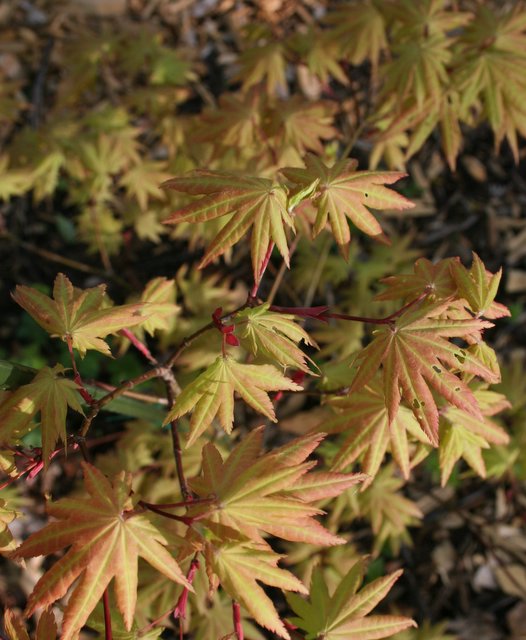
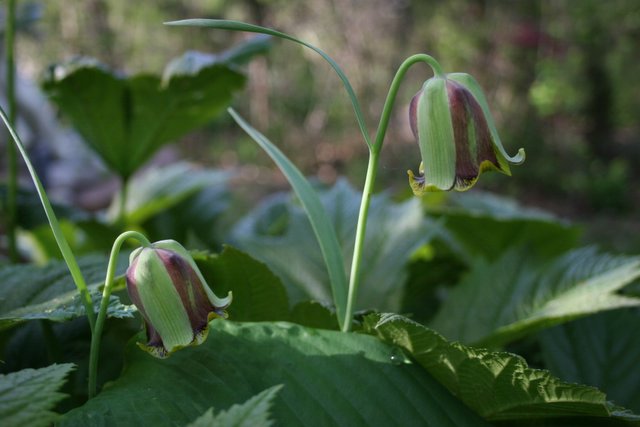 Fritillaria acmopetala might be the overall most satisfactory fritillary; it is tall, elegant, with waxy, exotic flowers that are long-lasting, and every bulb is surrounded by babies. If you like fritillaries (and who doesn't) this bulb is for you.
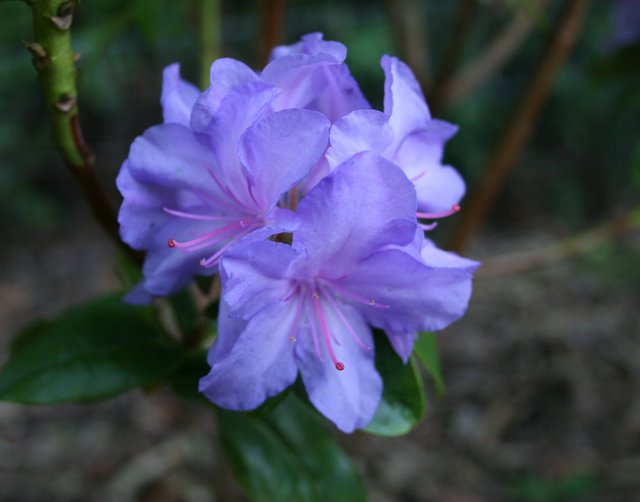 Rhein's Luna, pictured above is a new addition to the garden this spring. It is lavender blue, but my camera seems to like the color blue and has made it look more blue than it really is. It's still beautiful, and I have some hope for its long-term survival, but I don't get too attached to blue rhododendrons until they've at least seen their first Iowa summer and winter. Blue lepidotes apparently mainly get their color from the Rhododendron Subsection lapponica, a group of sub-alpine and sub-arctic small shrubs, that may tolerate winter (or may not, if no snow cover, which is often the case here), and dislike or hate hot weather. R. augustinii gives the best blue, but it turns up its toes here in the midwest, as do most of its direct progeny. Another lapponica, R. russatum, imparts a more purple blue, but is a little hardier parent, and russatum crossed with augustinii (thus russautinii) is half-way in between in both color and hardiness. If russautinii is crossed with a very hardy parent, it has some chance of survival here, and may give lavender blue flowers. Rhein's luna is russautinii X minus Carolinianum, so I have hopes. Bluenose, which I'll show later, when it blooms, is quite hardy here (russautinii X dauricum) but is prone to bark split on the trunk if winter sun hits it. It is a real beauty, a lighter lavender blue, and I love it dearly, and always ooh and ah every spring when it blooms next to a baby pink rhody.
 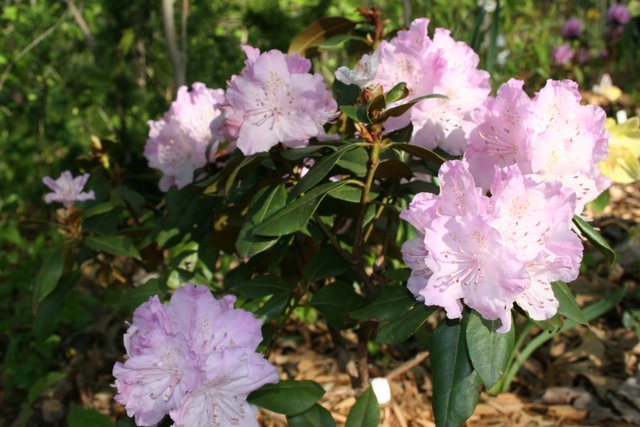 I recently showed a single truss of Rhododendron Hindsight; this just shows the plant better. It's a lepidote that almost looks like an elepidote, with its larger leaves, that it gets from its minus Carolinianum parent, and larger flower trusses than most lepidotes. The flowers are a nice, light baby pink.
 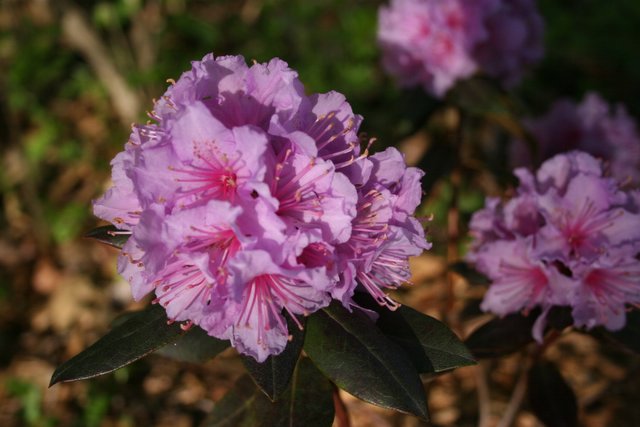 Rhododendron Shorty has a nice, bright pink color, with subtly deeper colored spots in its throat, and nice trusses for a lepidote.
 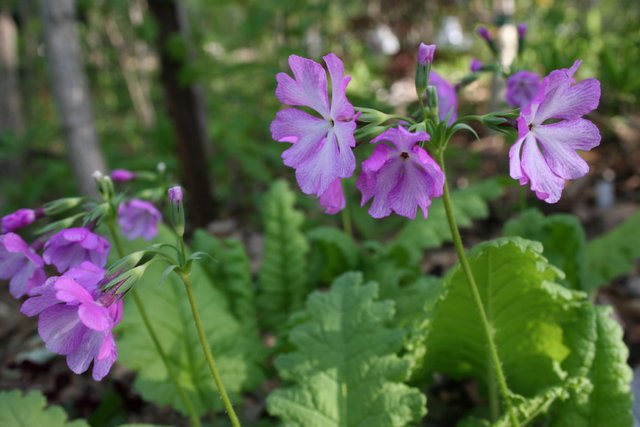 Primula sieboldii certainly has a lot of pluses for a gardener in the land of corn... not the least of which is its hardiness; by dint of having its foliage die back in the late, hot summer, it tolerates drought and heat better than its alpine brethren, and its foliage remains underground until moderately late in the spring, thus also avoiding winter, and then severe early spring freezes. Sieboldii's foliage therefore always looks very crisp and lettucy, offsetting its delicate flowers nicely. It's never quite been a WOW type of primrose for me, though: it doesn't form tight clumps, preferring to meander about loosely, and its pale pink-lavender flowers are sort of delicate and scattered. I may be changing my mind though; a couple of years ago I picked up a purple form of sieboldii...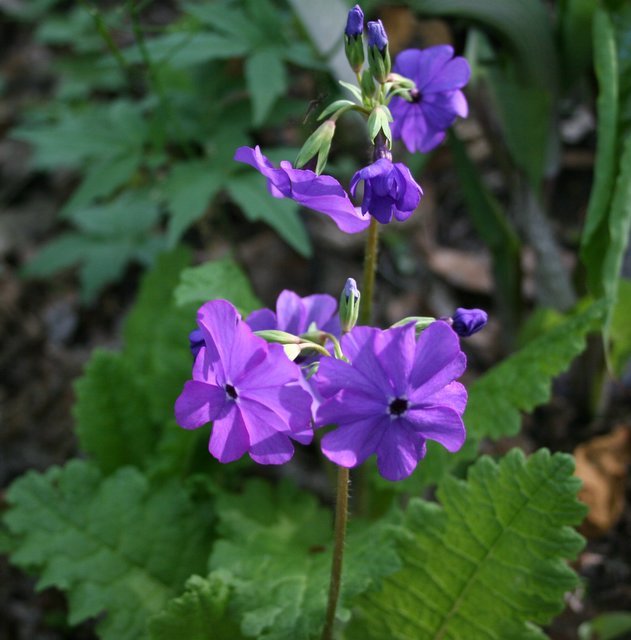
 You can't have too many daffodils... or can you? I suppose there are ten thousand daffodils in our garden. Now mind you, I didn't set out to have that many, but daffodils are the rabbits of the bulb world; after a few years, you've got them coming out of your ears. That in itself isn't a problem... I never met a daffodil I didn't like. The problem is that I've been living on borrowed time with my daffodils; you plant one bulb, and soon you've got nice clumps everywhere, with flowers uphill and down, their bright little faces shining in the spring sunshine. Eventually though, those clumps become crowded masses of bulbs, and the blooming rapidly goes downhill. I've done some minor redigging the last few years, but other important jobs, like keeping an eye on the local birdlife, and zipping out on the lake in our boat, always seem to come along just when I should be digging daffodil bulbs. This year, though, I've got to bite the bullet, and probably dig up, and split up perhaps two or three thousand bulbs. This is the dirty side of gardening that they never tell you about.