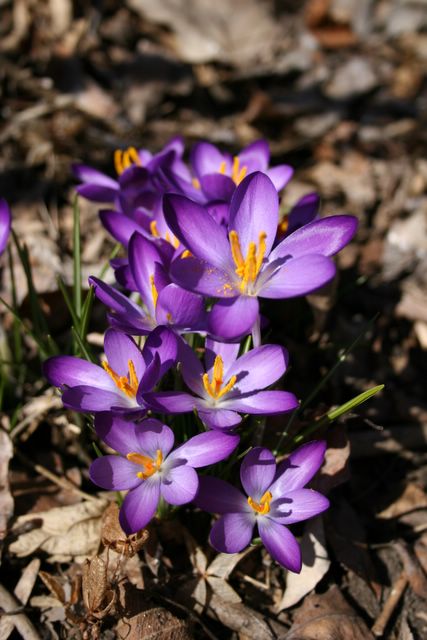
Thursday, March 31, 2005
Primula X pruhonica
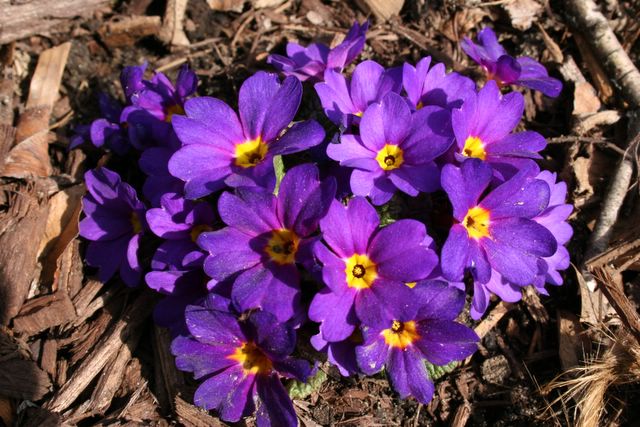

Hepatica
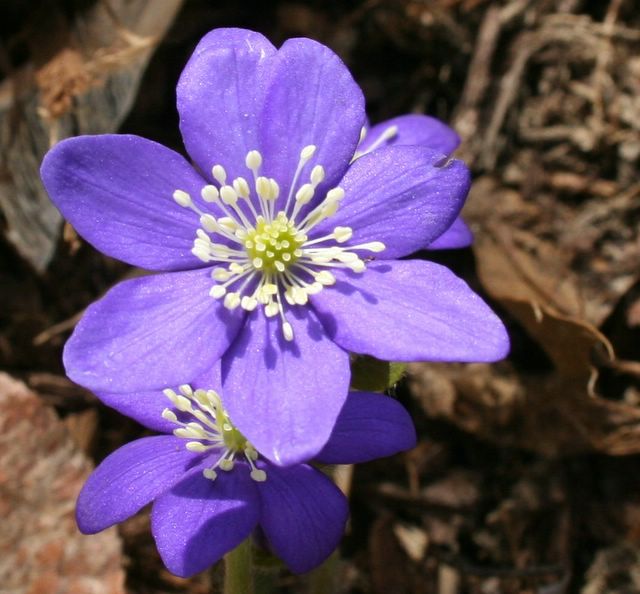
Never Mind
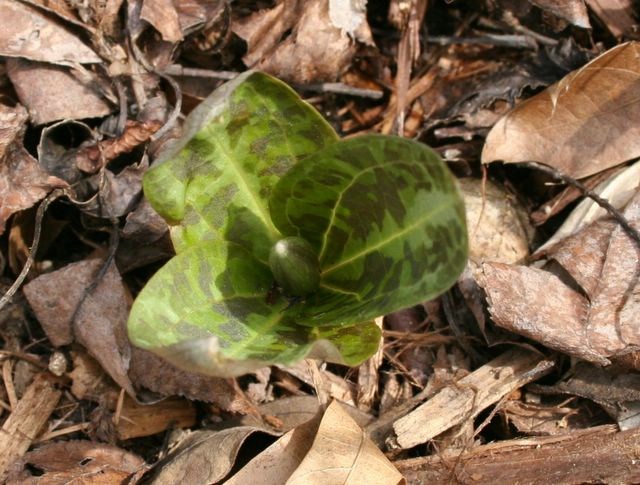
Well, overnight, Trillium cuneatum, grandiflora, and sulcatum just exploded out of the ground. No T. lutea, though... I may have to dig down a little and check it out.
Wednesday, March 30, 2005
Comment Conundrum
It has just been brought to my attention that the comment system on this blog has been being naughty, and making it difficult to post comments. This seems to have been coincident with changing the blog template to create a more pleasing background for the viewer's eyes. In the chageover I may have inadvertently activated a filtering mechanism which prohibits the posting of any comment not fully agreeing with your author's point of view. This has hopefully been corrected; if the system still does not work for you, leave me a comment.

Trolling For Trilliums
With a warm, windy day, the first bumble-bee popped out of its burrow and was bustling up the pathway, buzzing its wings to dry them for its first flight. I thought this was a good chance to get a close-up photo, but it was gone by the time I came back with my camera. This may be just as well, as I still remember as if it was yesterday, when as a four year old, I used a long stick to poke a bumble-bee as it was sunning on the spirea bush in the back yard. I made it half way to the back door before he caught me and stung me on the tip of my little finger, which swelled up to the size of a banana. There were new plants popping up everywhere in the garden today, but I was looking for trilliums, which seem tardy this year. I think I need to keep a garden journal, because I have a feeling I think the trilliums are tardy EVERY year, but more so this year. A couple of stalwarts shown above (underwoodii, the long bract wakerobin, and recurvatum, our prairie trillium) are just beginning to unfurl their leaves, but where are catasebaei, cuneatum, flexipes, grandiflorum, luteum, and all the other three-leaved jewels of the shady, moist nooks and crannies? I must confess I have a very bad habit of using my fingers to gently dig down and try to see if anything is going on, when some plant doesn't appear early enough for me. You would think I would know better after last spring. I had obtained a small bulb of Nomocharis, a rare and difficult lily relative, and had planted it the previous spring. It went dormant in August, preferring cooler climates, so I wasn't sure if it would come back,and so the following spring I gently dug down, and was thrilled to find a plump, healthy bulb. I carefully covered it back up with loose soil, but the next day I found my precious bulb (or the few crumbs that were left of it) lying on the ground, where a chipmunk had used my convenient tunnel to dig out the bulb and eat it.
I tell myself that there should be some point where I have enough different plants popping up in the spring that I don't fuss over one or the other, but so far I haven't reached that point, even though I'm at that stage now where little things sometimes pop up, and I have no idea what they are or where they came from. My dear Mother-in-law has a tiny garden, but she's always wondering about WHO planted the crocuses, or lilies, or whatever, that mysteriously continue to pop up in her garden. I know a couple were planted secretly by my Sister-in-law, but I've always wondered if some of these surprises weren't Wal-mart specials that my Mother-in-law bought and forgot about . I'm hoping that I'm not just an aging gardener who has progressivly more surprises to look forward to every spring. The cuty below mysteriously just appeared; I think it may just be an aconitum (monkshood) volunteer, but the leaf is quite different from any other aconitum in the garden. Hmmm.
I tell myself that there should be some point where I have enough different plants popping up in the spring that I don't fuss over one or the other, but so far I haven't reached that point, even though I'm at that stage now where little things sometimes pop up, and I have no idea what they are or where they came from. My dear Mother-in-law has a tiny garden, but she's always wondering about WHO planted the crocuses, or lilies, or whatever, that mysteriously continue to pop up in her garden. I know a couple were planted secretly by my Sister-in-law, but I've always wondered if some of these surprises weren't Wal-mart specials that my Mother-in-law bought and forgot about . I'm hoping that I'm not just an aging gardener who has progressivly more surprises to look forward to every spring. The cuty below mysteriously just appeared; I think it may just be an aconitum (monkshood) volunteer, but the leaf is quite different from any other aconitum in the garden. Hmmm.

Monday, March 28, 2005
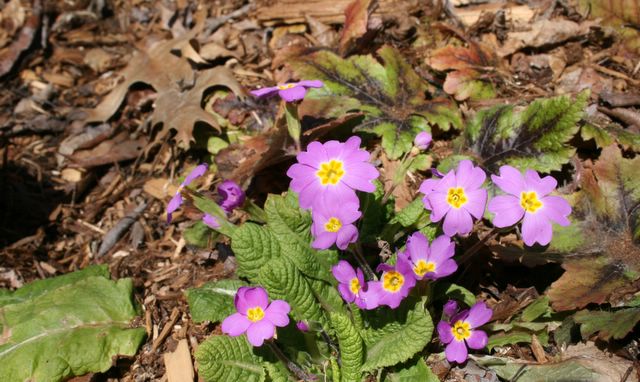
Primula acaulis ssp. subthorpii... I very much like this small primrose, as it doesn't look like it was just popped out of a greenhouse pot from Walmart... it looks more like a natural woodlands flower.

Sunday, March 27, 2005
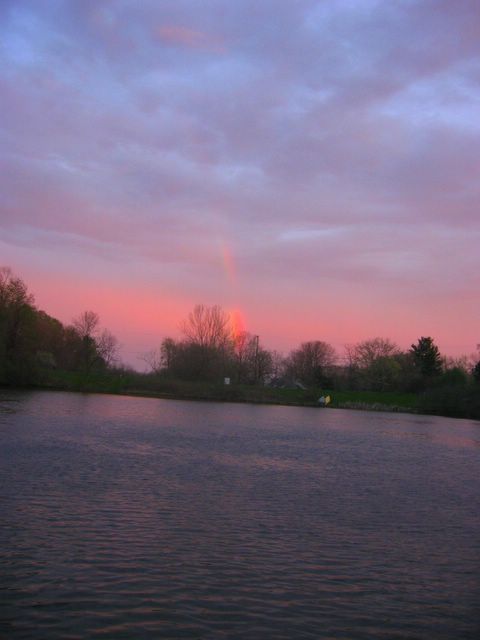

DNA in the Sky
I read recently that a prominent animal behaviorist claimed once that birds never do anything for pleasure or joy; all of their activities are just blind instinct. Call me sappy, but on evenings like this I find his statement hard to believe. Today as the sun set in the west, the sky turned a deep blue, of infinite depth and clarity, and a huge congregation of snow white sea gulls from the nearby lake began migrating up our little valley, and as they reached the head of the valley, where our land is, they entered a large thermal, with the warm sun heating the bare ground, causing heated air to rise rapidly through the still-cool atmosphere. The birds started spiralling higher and higher in this updraft , as more and more gulls came up the valley and entered the lower level of the thermal and joined the chase. Soon there were about a hundred birds riding this circular escalator to the upper sky. The gulls were under-lit by the bright , setting sun, so that they were blindingly white against the deep blue background, soon becoming small, glowing white dots far up in the sky, until they finally reached the top of the thermal, then spilled out in all directions and disappeared. How can something so joyous to see not be enjoyed by the birds themselves?
Perhaps I am a little soft and sappy. Thirty years ago I was a fellow in gastroenterology at U.C. San Francisco. Each year the department would have a dinner meeting at a famous steak house downtown, where everyone would drink too much wine, smoke a big cigar, and listen to a prominent speaker brought in for the occasion. One year they had Francis Crick of DNA fame, who unknown to me at the time, became well known in later life as an anti-vitalist; that is, he felt that life had no special meaning. Well, another fellow and I probably (likely) had a little too much red wine, and were sitting in a corner booth listening to Crick's lecture, trying not to slide under the table on those big leather seats, while holding our big, fat cigars. Crick set us up by starting out his lecture talking about the beauty of nature and life, then outlined the mechanism of the double helix: one could look at the long double chain like two long hallways, and the side chains that are then attached to it are like rooms leading off the hallways. The side chains have a unique chemical bond to the helix that is thermodynamically very difficult to break, so rather irreversible, so it's as though , as you walk down the hallway and enter a room, you cannot exit again. It is inevitable that if enough time passes, that the right combination of molecules will become randomly and irreversibly attached, and what we call life will arise, and what we call beauty, joy, love, are all just predestined by these mindless chemical side chains; the blooming flower, the little child's smile, the butterfly's beauty, are just quirks of a chemical bond, and have no deeper meaning than say, the formation of water from hydrogen and oxygen. Well, by this time my friend and I were practically crying in the corner, our tears trying to put out our big fat cigars. This, of course, is just the reaction that Crick was trying to achieve; with us it was just child's play. So, don't give me any of this mechanical animal behavior stuff; I've paid my dues... leave me my gulls flying in ever higher circles in the evening sun just for the sheer joy of it.
Perhaps I am a little soft and sappy. Thirty years ago I was a fellow in gastroenterology at U.C. San Francisco. Each year the department would have a dinner meeting at a famous steak house downtown, where everyone would drink too much wine, smoke a big cigar, and listen to a prominent speaker brought in for the occasion. One year they had Francis Crick of DNA fame, who unknown to me at the time, became well known in later life as an anti-vitalist; that is, he felt that life had no special meaning. Well, another fellow and I probably (likely) had a little too much red wine, and were sitting in a corner booth listening to Crick's lecture, trying not to slide under the table on those big leather seats, while holding our big, fat cigars. Crick set us up by starting out his lecture talking about the beauty of nature and life, then outlined the mechanism of the double helix: one could look at the long double chain like two long hallways, and the side chains that are then attached to it are like rooms leading off the hallways. The side chains have a unique chemical bond to the helix that is thermodynamically very difficult to break, so rather irreversible, so it's as though , as you walk down the hallway and enter a room, you cannot exit again. It is inevitable that if enough time passes, that the right combination of molecules will become randomly and irreversibly attached, and what we call life will arise, and what we call beauty, joy, love, are all just predestined by these mindless chemical side chains; the blooming flower, the little child's smile, the butterfly's beauty, are just quirks of a chemical bond, and have no deeper meaning than say, the formation of water from hydrogen and oxygen. Well, by this time my friend and I were practically crying in the corner, our tears trying to put out our big fat cigars. This, of course, is just the reaction that Crick was trying to achieve; with us it was just child's play. So, don't give me any of this mechanical animal behavior stuff; I've paid my dues... leave me my gulls flying in ever higher circles in the evening sun just for the sheer joy of it.
Saturday, March 26, 2005

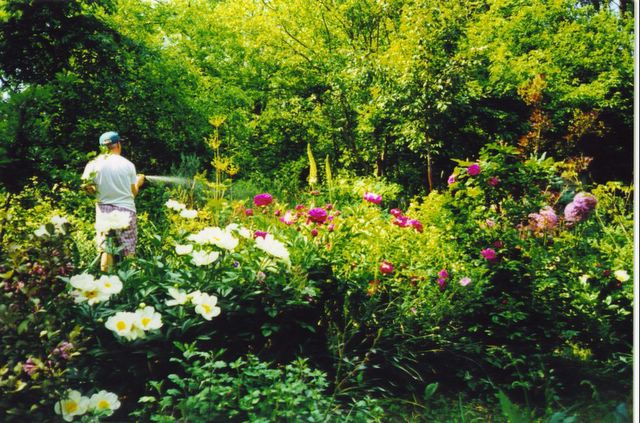

This is how the goldfish pond looked a couple of years after building it; now the garden has grown up around it even more.
Friday, March 25, 2005
Snain
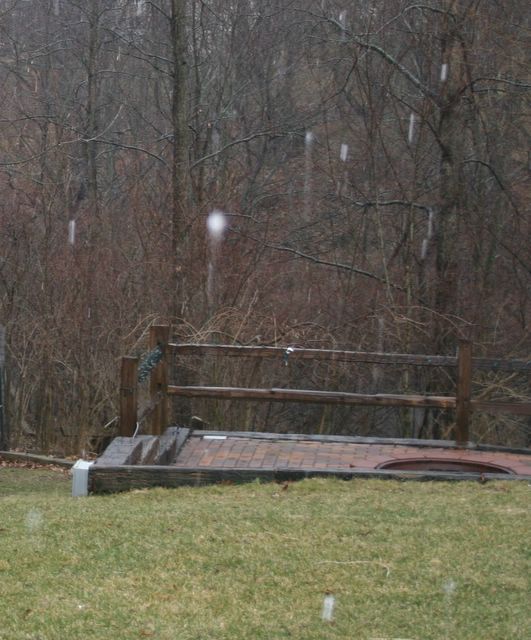
I remember when I was a tad, our Mom would read Pogo Possum books to us, acting out all the parts; she loved Albert the Alligator, and she'd start laughing so hard, she'd have to stop to dry her glasses. Well, one of the strips started out with, I think, Churchy and Howland Owl discussing the weather, with Churchy saying that everyone talks about the weather, but nobody does anything about it. Howland nods and says that saying came from Samuel Clemens. Churchy disagrees, saying it was Mark Twain, and they end up in a wrestling match over who said it, and they roll down a hill, into another cartoon strip. WELL, all I know is somebody needs to do do something about THIS weather! We had one of the warmest Februarys on record, causing all the plants in the garden to start growing, and now we've had a disgustingly cold, just downright nasty March, so that all the promise of an early spring has gone kaflooey, and all the plants in the garden are in a frozen sulk. Yesterday we had a cold snow-rain all day (snain?), and suddenly big blobs of slushy snow started falling straight out of the sky, hitting the ground with a splat! The kittens ran for cover under a fir tree, and I took this picture showing the snain coming down. Oh well, it's supposed to be in the 60's on Monday.Just don't e-mail me any pictures from the south or west right now, showing tulips and daffodils in bloom.
Future Critter Hotel

Since I published a picture of the old goldfish pond, this was the new goldfish pond under construction, in the middle of the garden, before the garden was so developed. Vaguely through the trees you can see the four acre pond at the bottom of the valley, the source of the critters that ambled, crawled, or hopped up the hill to snack in the goldfish pond.
Goldfish Pond
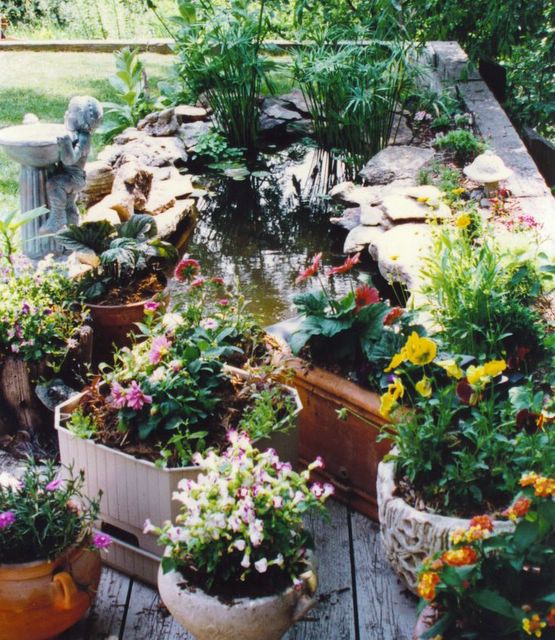
In the story "Critter Hotel", I mentioned our original goldfish pond right by our back deck. Liz was just sorting old pictures, and ran across this picture showing that pond... it's scanned in, so not as sharp as digital.
Thursday, March 24, 2005
The Haunting
Now, I've never believed in ghosts, but that doesn't mean I haven't experienced some spooky things. When I first moved back to Iowa as a young doctor, the first house that I bought had been built in a woods, with no yard, just trees growing thickly all around the house, with a long, winding driveway that led out to an unlit, dead end street. The odd thing about that house was that there was a cement sidewalk extending straight out from the back door, into the middle of the woods, and it just ended in front of a huge oak tree. There was nothing out there, and no seeming purpose to this sidewalk. Well, a few weeks after I moved in, my nearest neighbor stopped by to say hello, and in the course of conversation, asked if I knew that the fellow who had owned the woods before had committed suicide; it seemed one day he just walked out into the woods with a rope, and hung himself from the large oak tree which was at the end of the sidewalk to my back door. I used to tell guests that if someone knocked at the back door, don't answer! I was a young single fellow then, and must confess I used that story to get young, blonde fluffies to snuggle close in front of the fire.
The place we live in now is also somewhat isolated, but probably only haunted by the plants I've killed in the garden, though our neighbor girl, Alex, might beg to differ. Her mom, Kim, has taken care of our cats sometimes when we go on vacation, and once when Alex was about seven, she decided that she was old enough to feed them, so we showed her what to do. The two cats could let themselves into our attached greenhouse through a small pet door, so each morning Alex would walk down the hill and fill their double bowl with dry cat food from a large plastic jug that we also left in the greenhouse, and fill their water bowl. The first day everything worked fine, and Alex thought she was really hot stuff doing this all by herself. The second morning when she came down, and went in the greenhouse, the cat bowl was just gone! She looked all over and no bowl; she didn't know whether to be afraid we'd be mad that she lost the bowl or to be upset that someone was playing a trick on her, but she went into the house and got the other, identical bowl, and filled it with food from the jug. The NEXT morning when she came down, the whole JUG of cat food was gone! She ran up the hill, yelling "Mommm!", and wouldn't come near the place again, so her mom had to come down and feed the cats until we got back. We never did find the cat bowl, but about six months later I found the lidless, empty food jug down in the ravine, where the racoon who had drug it through the small cat door, had taken off the lid, and had a picnic.
The place we live in now is also somewhat isolated, but probably only haunted by the plants I've killed in the garden, though our neighbor girl, Alex, might beg to differ. Her mom, Kim, has taken care of our cats sometimes when we go on vacation, and once when Alex was about seven, she decided that she was old enough to feed them, so we showed her what to do. The two cats could let themselves into our attached greenhouse through a small pet door, so each morning Alex would walk down the hill and fill their double bowl with dry cat food from a large plastic jug that we also left in the greenhouse, and fill their water bowl. The first day everything worked fine, and Alex thought she was really hot stuff doing this all by herself. The second morning when she came down, and went in the greenhouse, the cat bowl was just gone! She looked all over and no bowl; she didn't know whether to be afraid we'd be mad that she lost the bowl or to be upset that someone was playing a trick on her, but she went into the house and got the other, identical bowl, and filled it with food from the jug. The NEXT morning when she came down, the whole JUG of cat food was gone! She ran up the hill, yelling "Mommm!", and wouldn't come near the place again, so her mom had to come down and feed the cats until we got back. We never did find the cat bowl, but about six months later I found the lidless, empty food jug down in the ravine, where the racoon who had drug it through the small cat door, had taken off the lid, and had a picnic.
Wednesday, March 23, 2005
Primula X Pruhonica
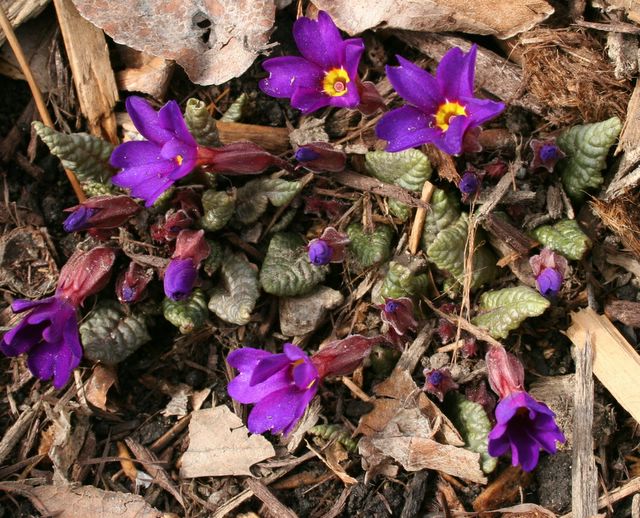
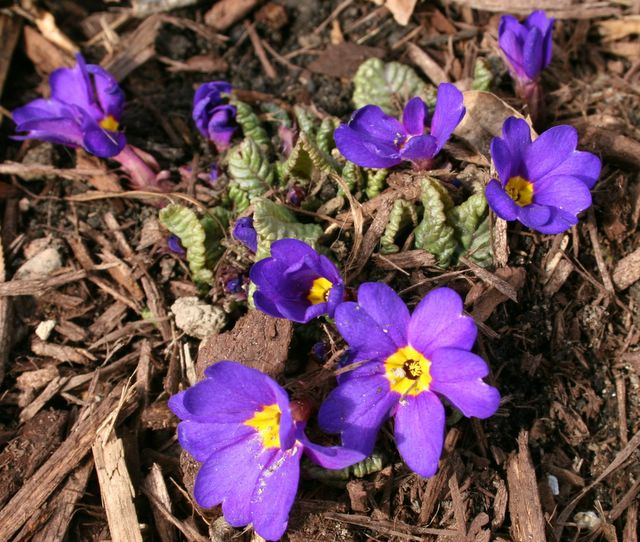
This morning we woke up to three inches of snow. At 10 the sun was out, and by noon all the snow was gone. A number of small, early primroses are starting to bloom... talk about cute! In an earlier entry I mentioned that a lot of the plants in my garden are best seen on hands and knees... for these tiny primroses you need to be laying on your stomach.


Monday, March 21, 2005
Wren Love
Spring has sprung, the grass has riz,
I wonder where the robin is.
I have had reports for weeks from gardeners in several parts of the State talking about robins arriving. Someone from Cresco, clear up north by the Minnesota border tells of robin flocks so large they scare small children and dogs. Meanwhile, we've sat here seemingly totally robinless. I was lying slug-a-bed this morning, staring out the window, thinking about this strange bird anomaly, when a fat robin landed flop-a-mop in the boxelder tree right outside the window, and hopped along the branch. Now I wonder if I just wasn't picking up on the robins, though it's hard to miss a bird the size of a loaf of bread, hopping across the lawn looking for worms. Still, I reflected that now that I thought about it, I didn't recall anyone EVER calling me a keen observer, which seems kind of strange, since there would seem to have been ample opportunity over the years. I must also mention that there was that thing about the Carolina wren. I had vaguely seen pictures of this southern song bird, but never expected to see a live one, until one January day three years ago, a male showed up at our feeder, nonchalantly pecking at the suet block. I got out my bird book and read that they occasionally get this far north, but often die off when winters get very cold. I read of his distinctive "tea-kettle" song; he was said to be one of the most persistent, and noticeable singers around. I only saw him a few more times that winter, but the next spring, I listened carefully for his call, in vain, and sadly concluded he probably had died in the cold of winter. Yet the next winter, a Carolina wren showed up at the feeder again... the same wren, a new wren... I didn't know. Well, last spring, again I heard no tea-kettle call, but in January the Carolina wren once again showed up at the feeder, acting like nothing was wrong. WELL! Then two weeks ago I was out in the garden watching the sun sparkle on the pond, enjoying the warm day, and right over my head I heard "tea-kettle tea-kettle tea-kettle". I then realized I actually had been hearing this call every single spring, but had been thinking it was an ovenbird, in the back of my mind thinking all along it was odd that sometimes there seemed to be an extra syllable in the ovenbird's "teacher teacher teacher" call. Also, I knew the ovenbird seems to sing in the late summer and fall. In my defense, I wouldn't call this wren a singing fool, which makes me wonder if he ever finds a mate up here in the north? Maybe he's just about given up, and is tired of singing "tea-kettle" and getting no tea???
I wonder where the robin is.
I have had reports for weeks from gardeners in several parts of the State talking about robins arriving. Someone from Cresco, clear up north by the Minnesota border tells of robin flocks so large they scare small children and dogs. Meanwhile, we've sat here seemingly totally robinless. I was lying slug-a-bed this morning, staring out the window, thinking about this strange bird anomaly, when a fat robin landed flop-a-mop in the boxelder tree right outside the window, and hopped along the branch. Now I wonder if I just wasn't picking up on the robins, though it's hard to miss a bird the size of a loaf of bread, hopping across the lawn looking for worms. Still, I reflected that now that I thought about it, I didn't recall anyone EVER calling me a keen observer, which seems kind of strange, since there would seem to have been ample opportunity over the years. I must also mention that there was that thing about the Carolina wren. I had vaguely seen pictures of this southern song bird, but never expected to see a live one, until one January day three years ago, a male showed up at our feeder, nonchalantly pecking at the suet block. I got out my bird book and read that they occasionally get this far north, but often die off when winters get very cold. I read of his distinctive "tea-kettle" song; he was said to be one of the most persistent, and noticeable singers around. I only saw him a few more times that winter, but the next spring, I listened carefully for his call, in vain, and sadly concluded he probably had died in the cold of winter. Yet the next winter, a Carolina wren showed up at the feeder again... the same wren, a new wren... I didn't know. Well, last spring, again I heard no tea-kettle call, but in January the Carolina wren once again showed up at the feeder, acting like nothing was wrong. WELL! Then two weeks ago I was out in the garden watching the sun sparkle on the pond, enjoying the warm day, and right over my head I heard "tea-kettle tea-kettle tea-kettle". I then realized I actually had been hearing this call every single spring, but had been thinking it was an ovenbird, in the back of my mind thinking all along it was odd that sometimes there seemed to be an extra syllable in the ovenbird's "teacher teacher teacher" call. Also, I knew the ovenbird seems to sing in the late summer and fall. In my defense, I wouldn't call this wren a singing fool, which makes me wonder if he ever finds a mate up here in the north? Maybe he's just about given up, and is tired of singing "tea-kettle" and getting no tea???
Sunday, March 20, 2005
A Sad Tale
In walking through the garden, there are lots of plants to see; some common, some uncommon, and some that are downright astonishing to find growing here in the middle of corn country. But, if you were to wander unattended down a back pathway, you might come upon a little pile of plant labels, and wonder where these plants might be; the sky blue corydalis, the diminutive primrose from the high Himalayas, the dove tree with its stark white floral display like so much laundry hanging from its branches. Well, sadly this is my plant graveyard, and let's face it, we all have a lot of chlorophyll on our hands. Of the plants I've lost though, one in particular is still painful to recall: Cypripedium formosan, perhaps the queen of hardy orchids. I have about six different terrestrial cypripediums that grow in the garden, but had always lusted after C. formosan, daunted by its cost, and the liklihood it would not survive our climate. I finally ran across one, though, at a price just below breathtaking, that I was pretty sure was greenhouse propagated, not plucked from the wild, and I sprang for it. I planted it in the fall in the very best spot in the garden, in a shady, moist ravine, with good drainage, and right by steps leading down to a bridge.Surprisingly it returned in the spring as if it was right at home, and it was beautiful, in all its pleated-leafed glory! I'd find an excuse to pass by it several times a day, and pictured myself casually pointing out the (by then) large colony of cyps to garden visitors, mentioning of course, that it was considered extremely challenging to grow by most gardeners, but had become somewhat of an invasive pest here, so that I periodically had to take the weed-whacker to it. Well, one day as I was gazing at it, I decided that what it really needed was a big grey boulder just behind it on the uphill slope to better show it off, and...
Well, as they say, whom the gods would destroy they first make proud. I have a nice little trillium planted in that spot now, but I still never walk by there without flinching a little. Of course I can hear you saying "Well of course I'D never do anything that dumb!" Ha!
Well, as they say, whom the gods would destroy they first make proud. I have a nice little trillium planted in that spot now, but I still never walk by there without flinching a little. Of course I can hear you saying "Well of course I'D never do anything that dumb!" Ha!
Saturday, March 19, 2005
Critter Hotel
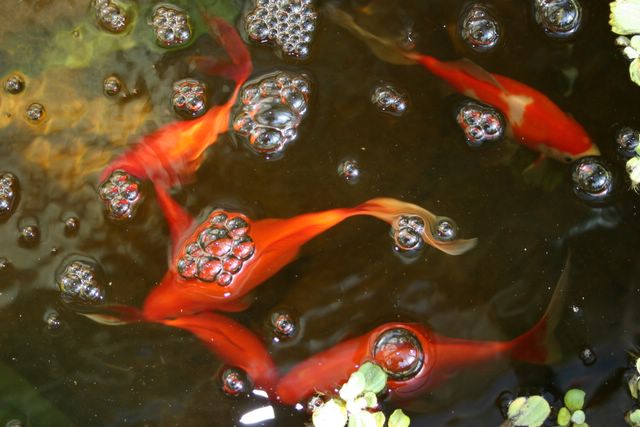
One of my minor chores in the cold months is to feed the goldfish. I bring them into the greenhouse in the winter and keep them in two large plastic stock tanks (along with the pond plants). They spend the summer in the garden in their pond. The pond was originally right by our deck at the back of the house, but about five years ago we did some extensive remodelling, and the contractor told me the original pond had to be moved. It was just getting so it looked really good, with a rock garden and dwarf evergreens around it. You know how in cartoons, when a character is told something distressing, his jaw drops clear to the ground? That's how I felt when I heard the pond had to go. The new pond is in the middle of the garden, quite a ways from the house, and while it's more natural setting and appearance are attractive to look at, they are also more attractive to the resident critters; it was like putting up a sign "Fish Buffet". That's not to say the original pond was completely safe. Once as I came into the house, I noticed a barred owl sitting in the black locust tree right by that pond, and called for Liz to come look at it. She told me she thought it was after the goldfish, which I scoffed at, never having heard of owls hunting fish. I had to admit, it was odd that the owl was sort of shuffling back and forth on the limb, and then SWOOP, he dove on the pond, and was gone with one of the fish. I got out my owl book, and found a whole chapter entitled "Owls as fishermen". Well, the new pond is even more of an attraction, a veritable critter hotel. A couple of summers ago was the worst, with the following guests: red-tailed hawk, bullfrogs, great blue heron, opossum, racoons, water snake, and maybe the final straw; coming out in the morning and finding a muskrat happily swimming around in my 10 foot by 4 foot goldfish pond. The worst of these pests though, was the water snake, which wiped out all of the smaller fish before I finally got it out of the pond. Water snakes are incredibly fast swimmers, and downright mean and nasty, and I finally had to half drain the pond to catch it. Liz volunteered to take it over to a nearby natural pond, so I put it in a styrofoam cooler for the trip, and put it in the back of her car. I had thoughts about putting an empty cooler in the back, with the lid ajar, but didn't, which is one of the reasons we're ssssstill happily married.
Thursday, March 17, 2005

FADD
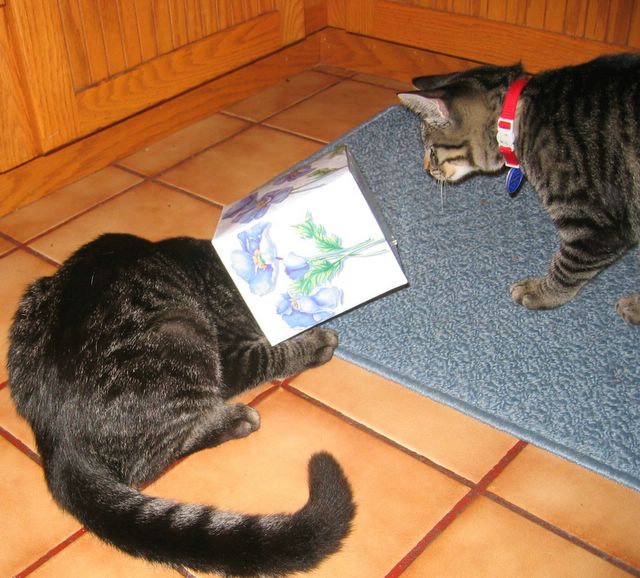
Getting new kittens from the animal shelter is fascinating, as you never know what personality is going to appear as your pet matures. Our two older cats were both sweet and laid-back; when one of them died at age 15, we brought home two new kittens; one of which is also pretty laid-back, and then there's Snickers. I think she has FADD: feline attention deficit disorder. Distraction is her middle name; it's not uncommon to see her sitting by herself in the middle of the lawn for 10 minutes, with her head constantly swivelling around in every direction, including straight up, just looking at who knows what (I say she's looking at everything and nothing in particular). Whether she's twenty feet up a tree chasing a squirrel, or pulling all the kleenex out of a box and scattering them around the house (or getting her head stuck in the box trying to get the last kleenex), she does nothing half way. She reminds me of myself when young, and I survived, and sort of grew up, so I have hopes for Snickers, but seeing her out on the iced over pond this winter, running back and forth as fast as she could, and then sliding across the ice in circles, made me wonder.
Wednesday, March 16, 2005

The UPS trucks are rolling... There are lots of signs of spring for gardeners, but what better one than the first spring plant order arriving in a big, brown truck. My first order came in today, from Arrowhead Alpines. The first plant I unpacked was this little pot containg a 5" tall specimen of a clone of Viburnum carlesii that was selected for particularly intense fragrance, and that it has; even at this size it perfumes a whole room. One can imagine what it will be like in the garden someday when it's 5 foot tall! One of our kittens came up as I was unpacking the plants,and got so excited by the fragrance, that she bit off part of an epimedium, and wanted to start on a primrose.
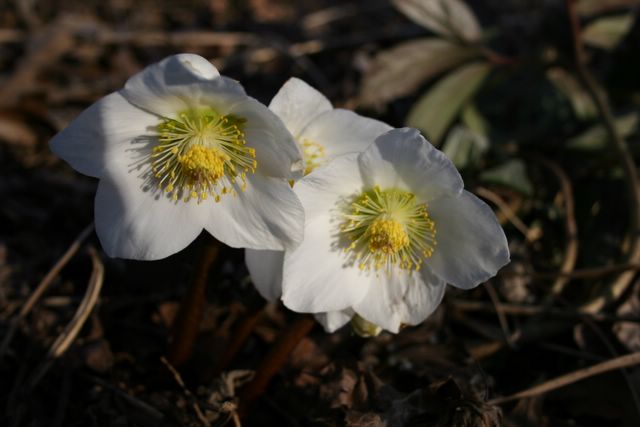
Helleborus niger... The evergreen foliage of this species was shown earlier; the pristine white flowers are now opening up.